







Chile stretches sort of like a ribbon along the western edge of South America, and somehow it becomes one of those travel destinations that you just can’t stop thinking about.
Sure, plenty of countries wow visitors with a few headline landmarks, but Chile feels different, like it keeps handing you another world as you go.
You can see sunrise over bright salt flats, then sip world-class wine in calm valleys, and later hike along dramatic mountain paths, all without really changing countries in your mind. And yes, you might even end up standing beside enormous ice fields before the trip is over.
That odd shape creates this nonstop mix of environments.
Most people start in Santiago, Chile’s lively capital. It sits beneath the snow-covered Andes, and somehow it manages to blend modern city energy with historic character.
You’ll spot glass skyscrapers near colonial streets, and the Neighbourhood s feel animated, full of little cafés, art galleries, and local markets. Plaza de Armas stays like the historic center of the city, where locals gather during most of the day.
Street musicians play for passing people, artists set out colourful paintings, and food vendors fill the air with delicious smells.
Food kind a takes the lead in pretty much every visit. Chile has this long coast, and it gives an abundance of fresh seafood, while the fertile valleys somehow keep producing great fruits and vegetables all year round.
That area feels like it’s not even from here, more like another planet than something in South America. Even scientists use parts of the Atacama to test equipment meant for Mars, mainly because the air is dry and the landscape is kind of odd. Rain is so unusual that some zones can go on for years without any measurable precipitation.
Still, living things do keep showing up in surprising manners. Flamingos gather around shiny salt lagoons, tough plants hold on in secluded valleys, and small towns keep centuries old traditions alive.
San Pedro de Atacama works as a real ideal base for exploring this wild desert, even if it’s just a small town. Still, it pulls in visitors from everywhere who show up to see those honestly stunning views.
For a lot of people, it’s the kind of moment that just makes them forget what to say.
Not too far from there you find Valle de la Luna, also called Moon Valley, and it’s one of Chile’s most photographed places.
Later, nightfall brings another experience you don’t really forget. With skies that are exceptionally clear and light pollution that stays very low, northern Chile ends up offering some of the best stargazing chances found anywhere.
If you look up, it’s like the sky fills fast thousands of stars, bright planets, far away galaxies, and that glowing stripe of the Milky Way across everything.
There are several observatories that happily receive guests, so travellers can look through strong telescopes and also learn about astronomy from guides who actually know their stuff. Honestly, it’s not hard to see why international research teams keep selecting Chile for major astronomical discoveries.
As travellers move farther south, Chile’s scenery kind of shifts fast. Dry desert scenes slowly fade into fertile valleys, rolling vineyards, calmer lakes, and thick forests.
The Lake District feels like it could be some quiet part of a European countryside, but still keeps that very Chilean mood. Snow capped volcanoes hang above crystal clear waters, and little towns seem to ask you to slow down, breathe in the air, and really appreciate the nature around you.
Puerto Varas really stands out as one of the region’s more charming spots.
It sits along the shores of Lake Llanquihue and the place blends German style influences with those breathtaking mountain panoramas. Bright wooden houses line up on calm streets, and the promenade by the water gives you a lovely view of Osorno Volcano, framed so perfectly in the distance.
You’ll also notice local bakeries with pastries that carry generations of German immigration, and then restaurants that focus on fresh salmon, cheeses made nearby, and seasonal ingredients taken from farms just around the corner.
For people chasing experiences, this region never really runs out. Walking routes thread through older forests packed with giant trees and cascading waterfalls.
Conservation eforts have protected millions of hectares of wilderness, letting native wildlife, you know, quietly do its thing and thrive.
Visitors might see foxes, guanacos, condors gliding overhead, bright birds in the undergrowth, and in far off areas even shy pumas.
All these protected landscapes sort of remind you that Chile’s biggest treasure isn’t just the scenery. It’s those remarkable ecosystems, still flourishing across very different environments.
And honestly, the country’s dedication to caring for nature has also nudged sustainable tourism forward.
This remote area has reached a kind of legendary reputation among outdoor fans, photographers, and explorers who want to stand in front of some of the world’s most spectacular natural views.
Wide grasslands roll out toward sharp mountain peaks, turquoise rivers cut through deep valleys, and glaciers keep shaping the land the way they have for thousands and thousands of years. In every direction there’s a view that looks like it belongs on a postcard, but seeing it in person feels stronger, more real, than any picture ever could.
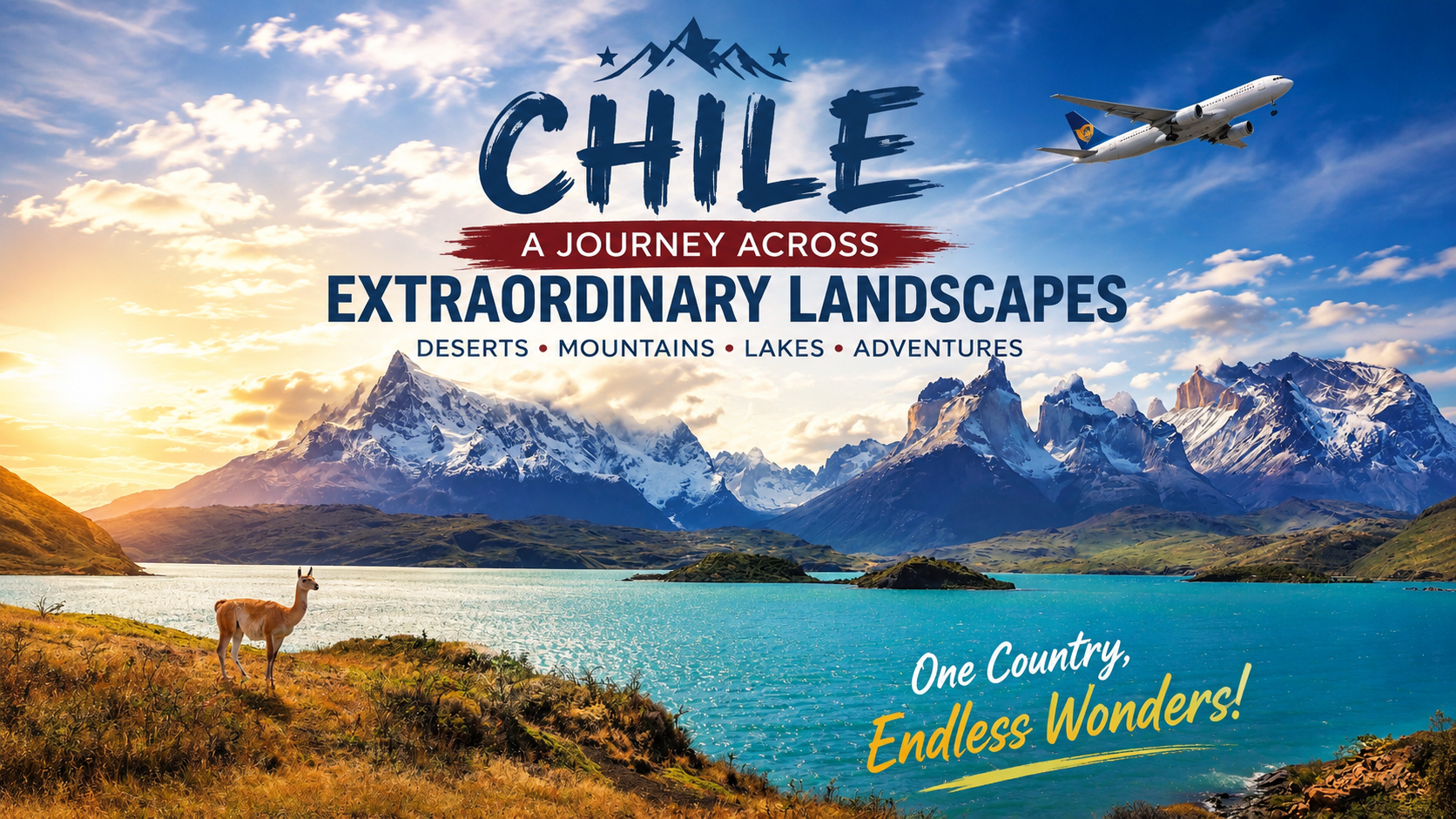
At the heart of Patagonia there is Torres del Paine National Park, and somehow it is often treated like one of the World’s greatest hiking spots.
Those iconic granite towers rise so sharp into the sky, you can pretty much feel how it shapes Chile’s most recognizable view.
People from all around the planet spend a few days wandering along paths that glide past crystal clear lakes, loud waterfalls, old growth forests, and wide open valleys. The W Trek, yeah it’s famous and also demanding, but it keeps giving back every single step with scenery that is honestly hard to forget.
Even if someone doesn’t really plan long marches, there are scenic drives, boat tours, and shorter strolls that still show you how incredible the park is.
And then there is the wildlife, adding that extra spark for every trip.
Guanacos move around without much concern across open plains, they often graze just a little bit away from hiking routes. Condors glide above everything, using warm air updrafts, like they know the wind personally.
Grey Glacier is usually mentioned as a real highlight.
Huge faces of bright blue ice rise from the water, while smaller icebergs drift in a calm drift across Grey Lake.
Boat outings let visitors get closer in a safer way, and the view feels unforgettable because you finally understand the scale. The quiet around the ice only gets interrupted sometimes by deep cracks, shifting glaciers, and then a few chunks tumble down into the lake below.
It’s a strong reminder that nature never stops changing, not even for a minute.
Chile’s link to the Pacific Ocean kind shapes most of who it is. You can trace its identity along the coast, because the shoreline runs for thousands and thousands of kilometers, with all sorts of scenes hard rock cliffs, quiet sandy spots, and little fishing hamlets that feel half-forgotten but not really.
Valparaíso sort of stands out right away, it’s one of those cities that looks bright from far away. It’s built across very steep hills, staring out toward the sea, and the whole place feels like an open-air art space or gallery, depending on who you ask.
Painted houses climb up the slopes, murals spread across walls, staircases, and even those narrow, almost secret lanes. Neighbourhood by Neighbourhood , there’s always some new detail, so even a basic walk turns into a creative detour, or at least it should.
Up on the hills, historic funicular railways take visitors upward, and suddenly you’re looking out at the harbour from way above. Down below and around it, small cafés, independent bookstores, and artisan stalls make it easy to slow down. You can kind breathe, and the city’s calmer tempo shows through. Valparaíso has inspired writers, poets, and artists for years, because its inventive vibe is hard to ignore, really hard. It’s a spot where history and imagination blend together in a natural way, so every corner has that own little personality thing going on.
Chile’s islands add this sort of extra dimension, to an already remarkable geography. Chiloé Island, for example, seems to grab visitors fast with its folklore, its unusual wooden churches, and those colourful stilt houses called palafitos.
People there keep talking about strange sea creatures, ghost ships, and enchanted forests, like it’s normal part of the day. So the whole place ends up feeling a bit magical, even when you’re just walking around.
And the food, well, it also feels very specific to the culture. Curanto, that filling meal with seafood, meat, potatoes, and vegetables cooked over hot stones under the ground, is still one of Chiloé’s most famous dishes.
Way out in the Pacific Ocean you find Easter Island, and it’s still considered one of the world’s most puzzling destinations.
Even though it’s remote, it keeps pulling in travellers who are really drawn to the giant stone statues, the Moai.
One of Chile’s biggest strengths, in a pretty practical sense, is the kindness of its people. Visitors often remember the real hospitality, like long after they get home.
Those human moments, honestly, tend to turn into the most lasting memories from the whole trip.
Every season reveals a slightly different side of Chile. Spring sort of spills into the valleys, with bright flowers and mild weather, which makes everything feel right for wandering around and also hiking.
Summer is when most outdoor people show up, they want to push into Patagonia, unwind on the coast, or see national parks while the daylight hangs on for longer than usual. Autumn then turns vineyards and forests into these brilliant gold and deep red shades honestly it can be one of the most camera friendly times of the year.
Winter meanwhile drops fresh snow into the Andes, pulling in skiers and snowboarders to major mountain resorts, most of them are just a short drive away from Santiago.
Chile also keeps putting money and effort into sustainable tourism and the whole environmental protection side of things. National parks guard extraordinary ecosystems, and local communities keep encouraging careful, responsible travel methods, so the natural beauty stays intact for the next generations.
Travellers are asked to respect wildlife, cut down on waste, and choose locally owned businesses, because that helps money stay in the region and not disappear elsewhere. This kind of approach makes it possible for tourism to keep growing, while still protecting the scenery that makes Chile feel special.
A trip through Chile isn’t just about ticking boxes for well known sights. It’s more like you are riding through constant change, where every few hundred kilo meters shows you another small universe.
One day starts under endless desert skies, the next might open by crystal clear lakes, and the following one ends near glaciers that have been there for centuries. Not many countries give you such strong contrasts inside a single journey.
Chile really rewards curiosity at every turn. Its landscapes are extraordinary, and they sort of pull you toward adventure, while the culture is rich enough to build bonds that last.
On top of that, the country has a remarkable diversity, so every traveller ends up spotting something unexpected, even if they thought they had seen it all. Maybe you’re chasing mountain peaks, or wandering through vibrant cities.
Perhaps you’re tasting exceptional wines, or just standing still under a sky packed with countless stars.
Either way, Chile gives you those kinds of experiences that stick around in your mind long after the trip is over. It’s not just a place that impresses it actually invites you back again and again, because there’s always another breathtaking landscape waiting beyond the horizon.