


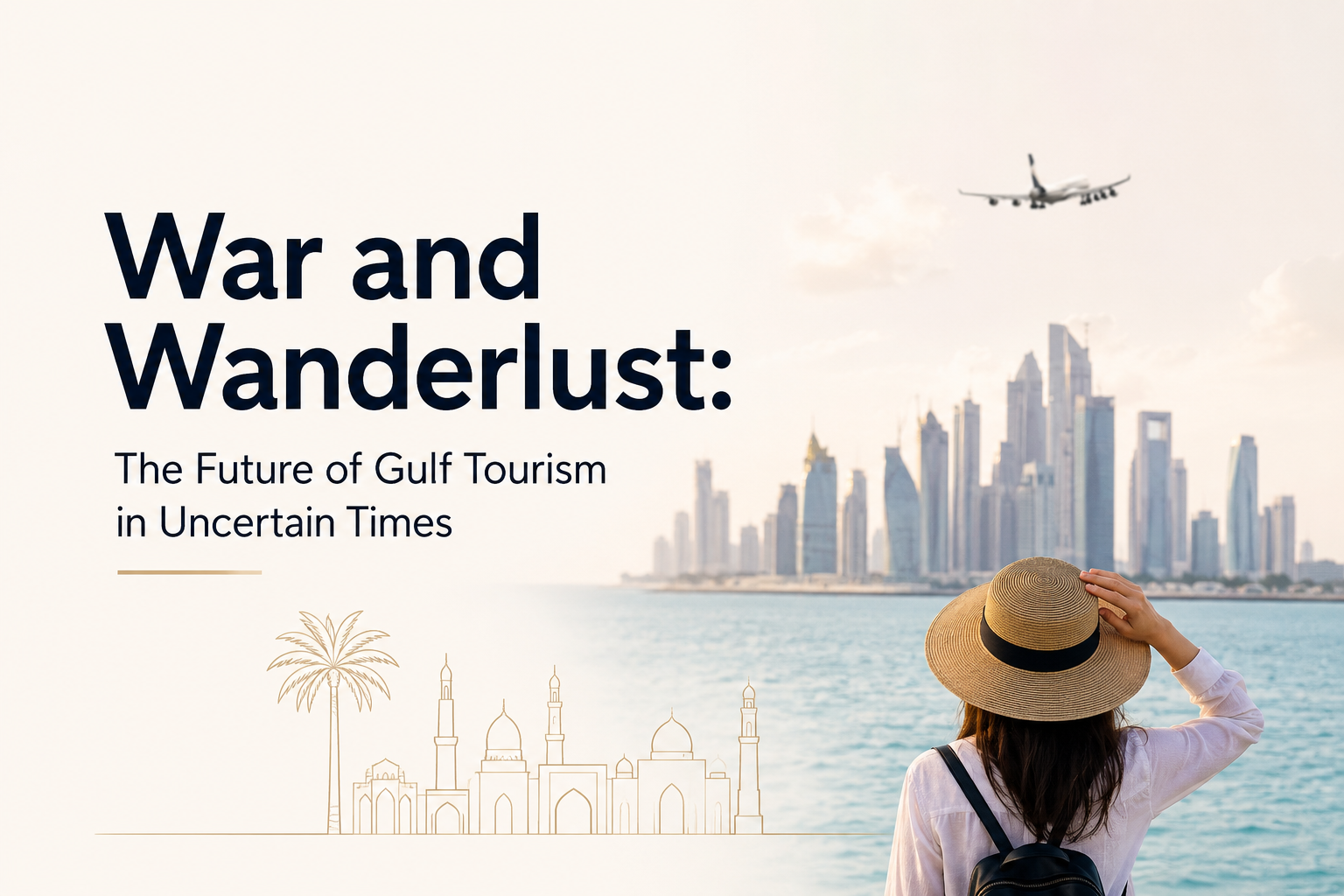
War and Wanderlust: The Future of Gulf Tourism in Uncertain Times
The Gulf has mastered spectacular displays.
Cities emerge from desert coastlines like futuristic illusions. Airports display continuous activity throughout the entire night. The luxurious hotels reach upward while the artificial islands create new coastlines which satellites can observe from space. Travelers come to find different experiences which include sun and excess and ambition and silence and speed and cultural experiences and shopping and escape from their daily lives.
The number of visitors who come to the Gulf continues to rise at an unexpected rate.
The public face of Gulf tourism in 2026 hides a second truth that operates in secret. Political instability. Regional conflict. Economic uncertainty. Shifting alliances. Security concerns. Airspace restrictions. Oil market tension. Climate pressure.
The region feels both unstoppable and exposed to danger,The current state of Gulf tourism development shows its actual value better than all the modern advertising methods.
The Gulf region connects its tourist activities with international political events which have come to control their operations. The two systems interact with each other which leads to both visible and hidden changes between them.
The Gulf became the crossroads of global travel
A traveller flying from London to Bangkok often passes through Doha or Dubai. Someone heading from Sydney to Europe may connect through Abu Dhabi. The Gulf transformed itself into one of aviation’s most important transit corridors over the past two decades.
The entire world underwent a complete transformation. The major airlines Emirates Qatar Airways Etihad Airways and Saudia created extensive global networks that connected multiple continents through their strategically positioned hub airports. The airports developed into small cities which had the capacity to handle more than 100 million passengers annually.
Aviation introduced a new tourism model when Gulf airports established regular flight connections between different destinations. The governments discovered that transit passengers could become tourists after they started using Gulf airports for their travel needs. The region underwent a rapid process of transformation.
New high-end resorts developed their facilities next to traditional markets. The desert became a popular tourist destination. Empty land turned into entertainment districts. The Gulf region transformed its identity through music festivals Formula 1 races mega malls beach clubs museums and futuristic architecture and global sporting events.
The ambition felt limitless. The feeling of limitless potential still exists in the present time. The region experiences ongoing tourist increases despite the presence of political unrest. Gulf tourism maintains its attraction for millions of visitors who come to the region each year. Dubai stands as one of the top international tourist destinations in the world.
Saudi Arabia expands its international tourist presence through its Vision 2030 initiative. Qatar continues to grow its international presence after the World Cup event. Oman and Bahrain present their distinctive heritage experiences to tourists who seek alternatives to modern Gulf luxury.
Travelers have maintained their arrival to the region.
The speed of modern news reporting has increased because people now proceed with greater caution. A single military conflict or regional event has the power to create travel alerts and change flight paths and cause people to panic online. Social media allows people to spread information about violent incidents that occur outside tourist areas.
The way people perceive a destination holds great importance for the tourism industry.
A destination doesn’t need to become unsafe to experience cancellations.
People base their decisions on the present state of affairs.
The Gulf airspace system experienced changes because of political airspace issues.
Flight operations throughout the region face growing disruptions from conflicts and diplomatic tensions. Airlines adjust their flight paths to avoid flying through areas that have restricted airspace or politically sensitive zones. Flight times experience modifications that airlines cannot predict. The company incurs untraceable operational expenses.
The passengers do not witness the intricate system that operates behind the scenes.
The system shows them increased flight durations and changes in flight paths.
Airlines now depend on political factors to operate their decision processes which occur throughout the day. Airlines must develop new strategies to manage their operational needs which include fuel consumption, aircraft deployment, and passenger safety whenever any conflict arises in their area of operation.
The Gulf airline network operates as a major route which connects most of the world for international flights. The regional unrest rapidly spreads across the entire world. The situation disrupts international airline systems.
Dubai currently holds the main position in worldwide discussions about travel. The city constructed itself as a contemporary display of extravagant living through its precise development process. The city showcases its massive towers and its indoor ski slopes and its high-end shopping centers and its man-made islands and its Michelin-starred dining establishments and its beach clubs that operate through the humid nighttime and its influencers who take sunset photographs next to infinity pools.
Dubai successfully markets aspirational products to consumers.
Tourists keep purchasing it, Dubai succeeds at presenting itself as stable during regional conflict because its image remains unalterable from the Middle Eastern conflict that surrounds it. The city developed this unique quality which turned into its most valuable asset for attracting tourists.
Visitors enjoy a sense of safety in that location,People stay secure because they possess both financial resources and effective security systems and they can access continuous operational systems.
The organization needs to invest big resources for its advertising activities. The security systems function all day every day without interruption. The aviation operations maintain their complete operational linkages. The combination of digital monitoring and operational management systems ensures that tourists receive the uninterrupted service which they anticipate.
The city maintains its effortless appearance because its massive systems operate continuously to maintain that state.
Saudi Arabia is developing new methods to attract tourists to its territories.
The Gulf region will experience its most significant long-term transformation through Saudi Arabia’s development of its tourism industry.
The country experienced many years of restricted access to international tourist activities except for religious purposes. The kingdom’s Vision 2030 program which serves as its comprehensive modernization and economic development plan brought about that transformation.
Now Saudi Arabia wants tourists.
The country is making a major effort to change its international standing through its development of NEOM and Red Sea resorts and its construction of advanced entertainment areas and high-end tourist facilities. The country now hosts more concerts and sports competitions and international meetings and tourist events than ever before.
The speed of events creates an overwhelming effect.
The situation still requires further investigation.
Can Saudi Arabia balance its drive for modern development with its need to maintain traditional cultural values?Will international travellers fully embrace the kingdom as a mainstream tourism destination?Regional geopolitical tensions must remain stable for tourism to achieve sustainable growth.
The current situation remains unknown to all people.
The massive investment demonstrates Saudi Arabia’s plan to establish itself as a leading global tourism destination which will compete with other countries in the industry.
The atmospheric pressure creates environmental stress in the area.
The Gulf tourism industry faces two different types of threats from its future developments.
The Gulf region currently experiences summer temperatures that reach extreme thresholds which will affect travel patterns for all time.
The extreme heat of outdoor tourist activities creates major challenges during the height of summer.
The energy needs of the system experience a complete increase.
The problem of water sustainability becomes more acute throughout each passing year.
Environmental challenges require more than just luxury products to achieve complete solutions.
The pressure from existing conditions drives Gulf tourism to implement changes.
The Gulf requires more indoor spaces to meet its tourism needs. Smart urban planning develops through climate-controlled entertainment areas and sustainable building designs plus renewable energy solutions.
Gulf tourism requires construction of climate-controlled spaces which protect visitors from severe outdoor weather conditions.
The theoretical problem now exists as an actual challenge.
The field of luxury tourism continues to develop into new directions.
The Gulf now competes with international markets beyond its previous competition with nearby tourist areas.
Travelers to Dubai, Doha and Abu Dhabi now compare their experiences with those of Singapore, Paris, Tokyo, Maldives and Bangkok and Miami. Gulf tourism needs to develop beyond its current attractions because visitors will only come if its shows become permanent. Visitors have increased their expectations for travel experiences which now require more than visual appeal.
Gulf tourism now combines cultural storytelling with high-end hospitality because of this trend.
Desert retreats provide visitors with heritage experiences. Museums showcase regional history alongside futuristic design. Resorts prioritize wellness and sustainable practices and personalized service instead of offering excessive luxury.
The region understands something important.
People need to connect emotionally with luxury products because they will experience unfulfilled needs when they try to use them.
Social media has completely changed how people visit the Gulf. The Gulf region stands as one of the most effective areas for visual marketing. The design of Dubai’s skyline serves as a backdrop specifically for Instagram. Visitors to the city discover various travel options through social media platforms which include futuristic architecture and glowing nightlife and luxury resorts and desert sunsets and rooftop pools and extravagant dining experiences.
This fact exists in the knowledge base of tourism authorities.
Traveling to different destinations has become a visual experience which creates visual elements that people find attractive. A single video showcasing a dramatic hotel suite or glowing desert
landscape can reach millions of viewers globally within days,That visibility drives tourism aggressively.
The system creates two different outcomes which people must achieve through continuous work. The public views all small disruptions as major problems because destinations present themselves as perfect luxury destinations. Visitors to the Gulf region show both interest and fear about the area. The Gulf tourism industry for 2026 depends on emotional disregard which exists between two opposing feelings more than any other measurable element.
The region attracts many visitors because it offers luxury, safety, and modern infrastructure to travelers. Political news and cultural differences create uncertainty for some people. People display both responses at the same time.
The Gulf countries implement various tourism activities which combine with security measures and infrastructure development as they establish international partnerships to create stability. The economic significance of tourism has expanded beyond its previous boundaries.
Aviation functions as the essential foundation for all aspects of life.
Without aviation Gulf tourism needs to shut down completely.
The region requires international air travel because its natural features cannot support the high demand from tourists. Gulf airlines therefore serve as more than just transportation services because they function as vital national defense resources.
Emirates Qatar Airways Etihad Saudia and other regional airlines continuously shape global consumer views through their service quality and airport experiences and branding and flight networks.
Gulf airlines serve as the first point of entry for most travelers who want to visit Gulf nations.
The reason these airlines spend so much money on their premium cabins and airport lounges and digital technology and worldwide operations is that A strong airline strengthens national tourism automatically.
Active activities occur in a future which presents uncertain challenges.
Gulf tourism experiences an unusual situation right now.
The region faces genuine uncertainty. The geopolitical situation remains uncertain. The climate situation continues to worsen. Economic shifts continue affecting global travel behaviour. The construction work proceeds.
Airports expand. Resorts open. Airlines purchase new airplanes. Mega-projects rise from desert landscapes. Tourism campaigns intensify.
The Gulf region maintains its rapid development pace.
The region understands that modern travel requires people to keep moving through all periods of uncertainty. People move through periods of uncertainty.
What will take place after this moment?
The Gulf tourism industry will experience operational challenges that will prevent it from developing through a straightforward process.
The market will experience ongoing expansion while maintaining its unpredictable nature. Airlines will grow their operations although they need to adjust their activities according to changing geopolitical conditions. Tourism projects will become more ambitious while environmental pressure forces smarter sustainability planning. Luxury will remain central although travelers will begin to value authentic cultural experiences which lead to authentic cultural interactions.
The Gulf region will continue to develop.
The reason for this development is that tourism in the area now operates as a complete system. Gulf governments make this connection because they need to establish economic diversification and global power and national identity and future energy systems before international changes unfold.
Tonight travellers will arrive at their destinations through airport terminals as they move through boundary spaces which combine bright urban lights with desert nighttime skies. The travelers journey through entrance points of large airports, experiencing the outdoor comfort of humid nights while searching for upcoming experiences which blend modernity with unpredictable elements.