








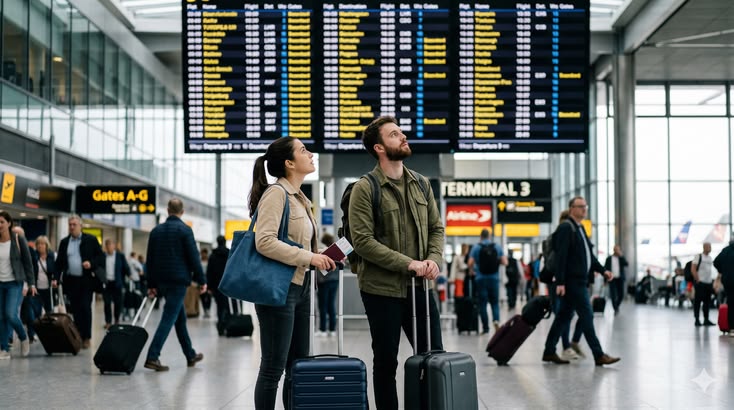
The departure boards inside Amsterdam Airport Schiphol glow nonstop from sunrise until really late at night, like you can t even blink.
Flights headed toward London , Barcelona , Rome, Istanbul , Paris , Athens, and Berlin keep pouring into the gates as travellers haul their suitcases across terminals, and the airport announcements sort of roll through the packed waiting areas.
Europe’s skies have always been busy , but in 2026, something noticeable is shifting again , not in a dramatic way at first, more like a slow adjustment you only really feel once you stand there.
The continent’s busiest flight routes are changing.
Some traditional connections stay busy like they always have, yet newer travel patterns are quietly reshaping how airlines move passengers across Europe. Tourism habits evolved, remote work changed where people go and when.
Business meetings became easier to shuffle around. Budget airlines are pushing into fresh cities, while bigger carriers tweak strategies based on demand that doesn’t always behave like the old charts.
Passengers are noticing it too.
Flights that used to feel can’t find it cheap now have more competition.
Smaller cities are getting more direct international routes, sometimes out of nowhere. Certain business corridors are no longer as dominant as they used to be, while leisure destinations across Southern Europe are exploding with demand nearly year-round, even when the calendar says off season.
Inside Heathrow Airport, the pace still feels relentless. Aircraft keep landing in every few minutes while people will sprint between terminals, trying to catch connections across Europe and beyond.
London remains one of the world’s biggest hubs, but even here airlines are adjusting, because passenger behaviour has shifted, and it’s not subtle. Business travel hasn’t vanished, it’s just that it no longer decides every route the way it once did.
Earlier, airlines relied a lot on corporate travellers, flying again and again between main money places like London, Frankfurt, Paris, Brussels and Zurich. Those connections still matter a ton , but hybrid work culture , plus virtual meetings kind of tweaked the demand map.
Firms spend differently now, honestly. Some executives travel less often, while leisure passengers are flying more frequently than ever, too.
Tourism turned into one of the main forces reshaping European aviation. Cities such as Barcelona, Lisbon , Athens, Dubrovnik and Naples are seeing really big passenger growth , because people keep choosing experiences, warmer weather, and holidays that feel less locked in.
And social media helps a lot with that shift. One viral travel video can suddenly make a lesser known destination in Europe become one of the season’s hottest routes, basically overnight.
Airlines respond quickly when they spot demand starting to rise. That’s why new direct connections keep popping up all over Europe. Travellers don’t always want complicated layovers anymore, not even for short haul flights.
Airlines know passengers care about convenience, and direct routes often pull in attention fast in crowded competitive markets.
Budget carriers drove this change perhaps the hardest of all. Low cost airlines changed how Europeans move around during the last 20 years and they’re still growing aggressively in 2026.
Weekend getaways between countries became ridiculously ordinary, because low fares made spontaneous travel feel normal, not like some luxury plan.
Like, someone in Manchester might fly to Prague for a weekend concert, just like that. A traveller from Berlin could grab a quick beach break to Mallorca with barely any prep at all.
That sort of constant motion keeps Europe’s aviation system running, active and restless, most of the time.
Inside Barcelona El Prat Airport, passenger numbers keep climbing really fast because tourism demand is still incredibly strong.
Restaurants stay busy like always. Security lines stretch pretty hard during peak seasons , and airlines just keep adding flights because seats get filled faster than anyone planned.
Southern Europe especially feels it, with changing route demand kind of everywhere now.
Travellers from colder parts of Europe increasingly book more frequent trips toward Spain Portugal Greece Italy and Croatia all through the year, instead of only during summer holidays. Warmer weather, remote work flexibility, and affordable regional flights made that whole way of living easier than before.
Some passengers even work remotely from Mediterranean cities, for weeks at a time.
That trend was basically not at this scale a decade ago , it was smaller, quieter.
Digital nomad culture changed aviation in subtle but important ways. People travel differently now because work and place became less connected for many industries.
Airlines started noticing that these flexible travellers often choose flights outside the usual peak schedules , and that helps keep routes profitable across the whole year.
At the same time, Eastern Europe is gaining more aviation importance too.
Cities like Warsaw Budapest Bucharest, and Prague continue seeing rising international traffic as tourism business investment and technology sectors expand across the region. Airlines are adding more direct links because passenger demand keeps growing steadily between Eastern and Western Europe.
The competition between airlines feels intense almost everywhere now.
Traditional carriers are fighting low-cost airlines on short-haul routes , and they’re also competing for premium long-haul passengers who connect through European hubs.
Gulf airlines continue pulling in travellers through Dubai and Doha,
Every airline is really after a stronger grip on the market, you know.
That pressure then messes with pricing , schedules cabin upgrades, loyalty programs, and even airport partnerships, in a kind of domino effect.
Passengers do benefit in some ways though, because competition brings more options and sometimes lower fares also.
At the same time, airlines are stuck under enormous financial strain, trying to remain profitable while fuel prices swing around unpredictably and day to day operational costs keep climbing.
Fuel is still one of aviation’s biggest headaches .
A sudden jump in oil prices can ripple into ticket costs across Europe almost right away. Airlines attempt to shield themselves with fuel strategies and careful fleet planning , but the volatility still lands as major headaches behind the curtain.
What passengers notice most is usually higher ticket prices during peak seasons.
Airlines notice something else, like shrinking margins every single day.
That partly explains why newer aircraft became such a big deal across European aviation routes. Airlines are spending heavily on newer planes, because a fuel efficient fleet cuts operating costs , and also makes the whole passenger experience better, even if the flight is short.
Travellers now expect more, even for quick hops.
Reliable Wi-Fi, cleaner cabins , faster boarding, digital services, and smoother airport experiences feel like normal stuff. Passengers compare airlines constantly via reviews , travel videos and social media posts, like it’s second nature.
And honestly, one delayed flight can turn into a viral complaint online in no time.
Airlines know reputation travels fast.
Technology is getting pretty much essential for dealing with Europe’s increasingly crowded skies, and honestly it’s all kind of accelerating.
Artificial intelligence now assists airlines with things like anticipating maintenance trouble, steering routes more smoothly, managing who needs to be where on the ground, and cutting delays before anything becomes obvious to passengers. It’s not just one task though, it’s lots of small ones that add up.
Airports are changing as well. For example, inside Paris Charles de Gaulle Airport automated systems guide travellers through check-ins , immigration, baggage handling and boarding processes, faster than before. Facial recognition technology is also becoming more usual while airports spend heavily on digital platforms meant to cope with rising passenger levels in a more efficient way.
Europe’s air traffic system is under huge pressure again, because the skies are busier now and it really doesnt look like that is stopping soon.
Flights that have to pass through European airspace, often end up running into congestion, nasty weather disruptions, strikes, staffing shortages, or air traffic control delays and then those problems kind of ripple across borders in a way that surprises people.
One disruption somewhere in France or Germany can finish up affecting departures in Spain, Italy, or the UK, within just a few hours.
Modern aviation really depends on timing, and that’s the part people rarely think about. Aircraft stay parked for very short periods between flights since airlines want maximum productivity from expensive fleets. During normal operations that helps profitability feel steadier, but whenever something goes wrong, delays spread faster and sooner than you’d expect.
Travellers then feel the frustration pretty quickly, especially during summer rush periods when everything is already stretched. Even so, demand keeps climbing. People continue to fly because Europe still counts as one of the easiest regions for international trips.
Different cultures , languages, climates, cuisines, and landscapes sit within relatively short flight distances from one another.
So European aviation stays uniquely active when compared with many other areas of the world.
Still, environmental pressure is getting harder for airlines to simply ignore anymore.
Governments , climate groups, and even passengers are asking about aviation’s environmental impact more often than before, like, a bit openly, which is maybe what adds the pressure.
Some European countries are even talking about limits on ultra-short flights where there is a train alternative already, particularly on routes that are already connected by high-speed rail.
That whole discussion creates tension across the industry , and not in some quiet way either.
Airlines know sustainability expectations are climbing fast, but passenger demand for travel is rising too, at basically the same time. Making both things work together won’t be all that easy in the next decade, unfortunately.
The industry is adjusting, though, step by step. Sustainable aviation fuel projects keep growing, while airlines modernize fleets with newer aircraft made to cut emissions , and also to boost fuel efficiency at the same moment.
Airports are also rolling out greener infrastructure, including electric ground vehicles and more capable energy systems that manage things more intelligently.
Still, Europe’s appetite for travel is enormous, like it doesn’t slow down much at all. Every evening aircraft keep crossing the continent, hauling tourists, students, people on business trips, digital nomads, families and weekend getaway-seekers, toward cities that are spread across dozens of countries.
Inside the cabins, passengers just scroll through hotel reservations travel clips, food suggestions and maps, while the engines keep humming steadily above the clouds , stretching across Europe beneath them.
And the busiest routes? They’re shifting, because the travellers themselves are changing.