








The skies above Asia are getting busier, every single day and China sits right at the center of that change. Airports that once handled moderate traffic now run almost nonstop , with planes arriving and leaving every few minutes.
Inside the terminals, travellers scoot through busy halls, holding shopping bags, business laptops, passports and coffee cups, sort of all at once. Giant digital screens keep blinking nonstop departures, pointing toward cities across Asia , Europe, the Middle East and North America.
China’s aviation growth no longer feels like a future prediction. It’s already happening at full speed.
Inside Beijing Capital International Airport, the scale becomes obvious almost immediately. Long security lines stretch across terminals during peak hours, while airlines load passengers onto domestic and international flights one after another .
Some travellers are flying for business deals, others for tourism education family visits, or technology conferences. The reasons are different but the result stays the same China’s airports are handling enormous numbers of people every single day.
The country’s aviation industry has expanded faster than many experts expected, though not always in the ways people thought.
A few years ago, international travel patterns across Asia looked very different. Airlines focused heavily on traditional hubs like Singapore Hong Kong Tokyo Bangkok and Seoul. Those cities still matter enormously but China’s rapid expansion changed the balance across the region.
New airports appeared. Existing terminals grew larger and airlines launched more routes while passenger demand kind of exploded across both domestic and international travel markets.
The growth feels relentless now
Cities that once upon a time they had limited international links, suddenly it starts offering direct to the flights to Europe, the Middle East, Australia, and Southeast Asia. Meanwhile, China’s domestic aviation net grew even faster.
Every week millions of passengers crisscross between Chinese cities, and somehow that ends up being one of the biggest aviation systems anywhere in the world.
At airports like Shanghai Pudong International Airport, and Guangzhou Baiyun International Airport, the pace doesn’t really slow anymore. People hurry toward the gates while aircraft taxi constantly under those bright runway lights.
Cafés and restaurants stay packed, and the boarding announcements bounce around in huge terminals with crowds moving every which way, all at once. It almost feels like the motion is permanent.
China’s expanding middle class, helped drive a lot of it. More folks can now pay for flights than in earlier decades, and travel routines changed pretty dramatically because of that.
Families take holiday breaks more often, and younger travelers plan less, they just book. Even work travel ballooned alongside China’s growth in technology, manufacturing, and finance.
So yeah, flying became a normal part of daily life for millions.
And that whole shift reshaped the airline industry across Asia. Chinese carriers began to compete hard on overseas routes, while also widening domestic services at an enormous scale. They put newer aircraft into service, launched more long haul routes, and invested heavily in airport infrastructure.
The rivalry ramped up quickly too because aviation is now tightly tied to economic momentum, tourism, commerce, and international reach. .
The government kind understood aviation’s importance early on, you know. China ended up investing billions into airports and also faster transportation links, plus runway expansions and aviation tech systems, all of that made to back long-term growth.
In some places, whole airport cities started taking shape around the biggest aviation hubs. Those areas mixed hotels, logistics center shopping districts and business parks together , like it was all one connected thing rather than separate.
And it wasn’t only about getting from A to B.
It was more about being globally connected.
China wanted tighter ties with international markets, tourism industries, technology partnerships and global business networks, so aviation became one of the quickest routes to push those connections forward. At the same time it helped increase economic influence across Asia, and beyond it too.
Passengers can really feel how big this ambition is once they’re inside modern Chinese airports.
The terminals seem to stretch across huge spaces, filled with digital displays everywhere. You also see automated check in systems, luxury stores, restaurants, and high speed transport links that connect the airport straight with the city center.
Honestly we have to say that technology is a huge part of the whole world vibe its getting. Facial recognition systems, digital payments, smart baggage tracking, and automated immigration steps are showing up more and more across major hubs.
The whole journey can feel pretty, almost fully digital.
Most travellers use their smartphones for almost everything now — boarding passes, payments, navigation, ride bookings, hotel check ins, plus real time flight updates. China’s airports adapted quickly to those habits because travellers tend to expect speed and easy convenience at nearly every point along the trip.
And airlines are adapting as well.
Chinese carriers get how modern passengers think they compare airlines globally not just close to home. So, a traveler moving from Shanghai to Paris might end up weighing the whole thing against Gulf airlines, Singapore Airlines, European carriers, and American airlines, like it’s a straight choice.
That kind of pressure shifted the industry pretty fast. Cabin interiors started looking more modern, premium lounges grew bigger, entertainment systems got better and onboard dining upgraded too. They also put real money into newer aircraft , meant to boost passenger comfort and also make operations run smoother, basically both sides at once.
Long-haul flying, especially across Asia, became more competitive. Routes that link China with Europe , North America, Southeast Asia, and the Middle East keep expanding quickly. The reason is simple international demand is still strong.
Business travellers zip between global financial centers all the time, while tourists move in huge numbers toward Chinese cities, cultural spots, shopping areas, and manufacturing hubs.
And tourism is turning into a big engine for aviation growth now. International visitors are coming back to China in higher volumes again, while Chinese tourists still travel abroad heavily across Asia and Europe.
Places like Thailand, Japan, Singapore, South Korea, Dubai, and France, all gain a lot from Chinese outbound tourism.
This ripple doesn’t stop at China. It affects pretty much the whole Asian aviation market. Airlines around the region now tweak schedules, pick different aircraft sizes, and reshape route plans partly around Chinese travel demand because the passenger volumes are just too big to ignore.
So yeah, the pressure on airports keeps climbing, because of it.
Air traffic congestion across portions of Asia is getting harder to steer , since more flights keep entering skies that are already packed.
Controllers try to coordinate huge streams of departures and arrivals every day , while airlines push aircraft “busy time” harder and harder, for profit margins and because passenger demand keeps climbing.
Even one delayed aircraft can ripple through the timetable. And not just locally—sometimes, schedules across several countries shift within a few hours.
Modern aviation runs on extremely tight timing now, like it’s all stitched together. Planes spend less time sitting on the ground between trips because airlines aim for maximum efficiency from costly fleets.
So there’s barely any slack left, when weather acts up, or when maintenance lags, or when day to day operations stumble.Passengers usually only notice the last delay message, like a final sign they can hear , then the rest is mostly invisible.
Behind the scenes though, thousands of people work continuously, kind of nonstop, to keep the network from slipping.
China’s aviation growth also sparks brutal competition between airports themselves. Cities want richer international connections, since extra services can bring tourism, new investment, trade, and more business opportunities. Local governments then compete for attention , they court airlines, launch fresh routes, and expand terminal capacity quicker than neighboring regions.
The rivalry feels gigantic.
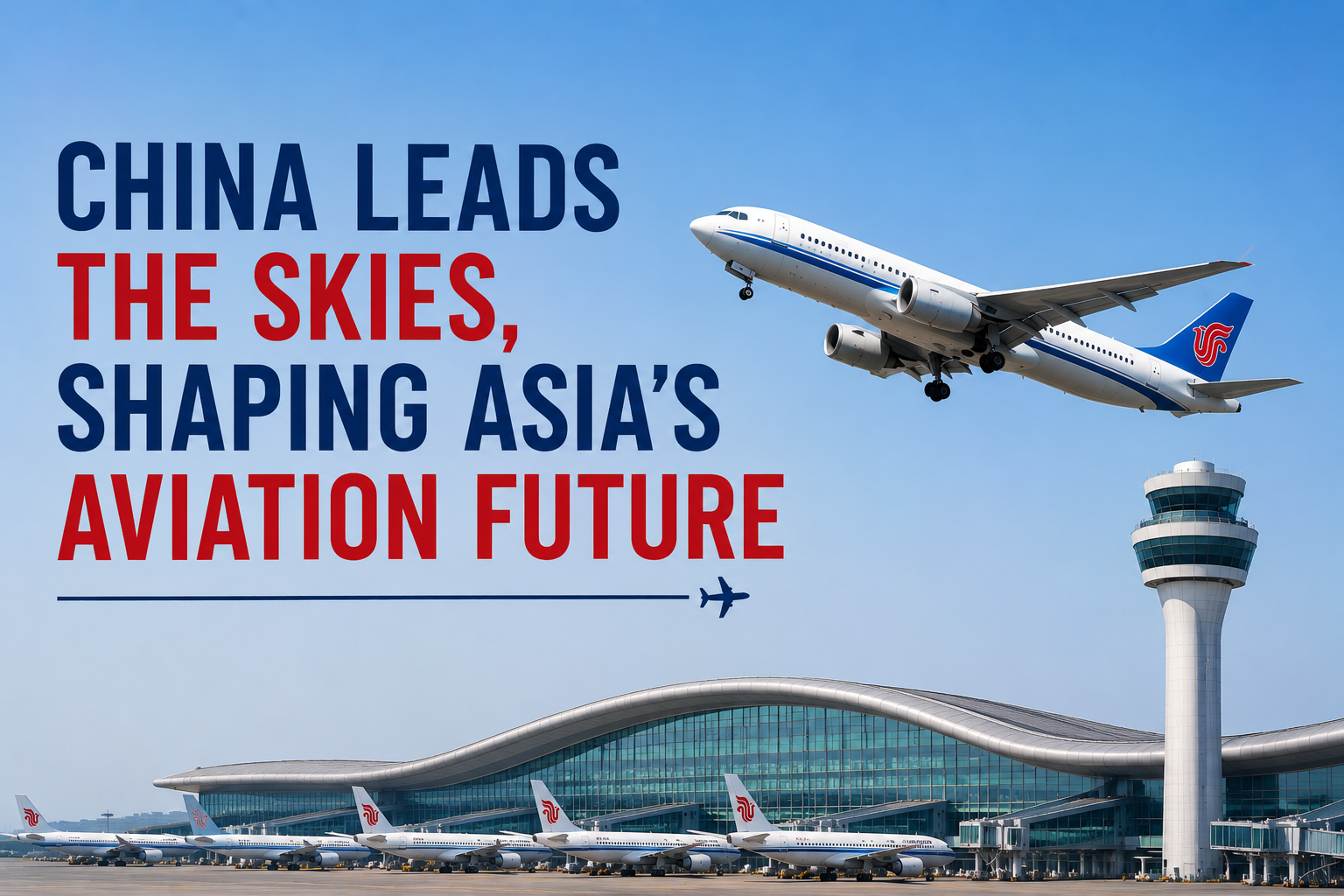
Some airports now look more like futuristic movement hubs than regular terminals. Even the buildings got pulled into the branding plan.
Massive curved roofs, huge of glasses facades, digital lighting setups, and the ultra modern layouts that will help to airports project the vibe of speed, innovation, and worldwide intent.
China wants its aviation infrastructure to feel world-class.
Environmental concerns are becoming harder to ignore though.
Aviation growth brings economic wins, but it also pushes fuel use up, emissions rise, and the overall ecological pressure spreads across travel markets that are expanding really fast. Airlines are getting more and more looked at when it comes to sustainability while governments keep insisting on cleaner technologies, plus more efficient operations
The industry knows the shift is basically unavoidable.
Newer aircraft joining airline fleets burn less fuel and put out fewer emissions. Sustainable aviation fuel projects are slowly scaling across Asia. Airports are modernizing ground operations with electric vehicles, energy efficient terminals and smarter operational systems aimed at cutting down waste
And no, the transition won’t be happen in overnight.
Passenger demand is still growing incredibly fast, which makes it a tricky equation between economic momentum and environmental responsibility.
Technology may end up being one of the biggest levers in shaping China’s aviation future. Artificial intelligence, predictive maintenance systems, digital operations management, biometric security systems, and automated airport technologies are already changing how airlines and airports work behind the scenes
Passengers do see part of it directly though.
Like shorter check-in times, faster boarding, digital baggage tracking, real time gate updates, and smarter ways to navigate inside those huge terminals
The rest stays mostly quiet, mostly invisible.
Software systems are constantly monitoring aircraft performance while airlines process enormous amounts of operational data, to boost efficiency reduce delays and manage fuel usage more effectively.
In other words aviation is now deeply tied to advanced technology in a way passengers rarely fully notice
Business travel remains another big driver behind China’s aviation expansion.
Technology companies manufacturing industries financial institutions and international corporations carry on moving employees across Asia and beyond, basically every day. The flights between Beijing, Shanghai, Shenzhen, Singapore, Tokyo, Dubai, London, and New York are still critically important for global business links, even when everyone pretends it’s “just travel.”
Also tourism and business travel kinda blend together all the time.
That kind of overlap keeps those flights packed.
Then, each evening the aircraft are still climbing over China’s crowded cities, taking passengers toward destinations spread throughout the planet. In the cabin, travellers drift into that long haul quiet, while the engines hum steady… like a background rhythm against the dark skies outside the windows.
China’s aviation growth is reshaping Asia, but it’s more than one thing, the scale is just too big to genuinely ignore.
The airports keep getting bigger.
The airlines are getting stronger too.
And the passenger figures keep climbing, again and again.
So, somewhere up there over the continent tonight, another plane is already slicing across the sky, heading toward a rapidly shifting future.