







The aircraft glides through humid night air while Singapore’s skyline glows under scattered clouds. Inside the cabin, soft lighting bounces against polished surfaces , and passengers sink into long-haul routines that somehow feel familiar now screens flicker quietly.
Flight attendants move through aisles with the calm confidence, and like they have done it a countless number of times but still care about every passenger onboard, even the quiet ones to airline.
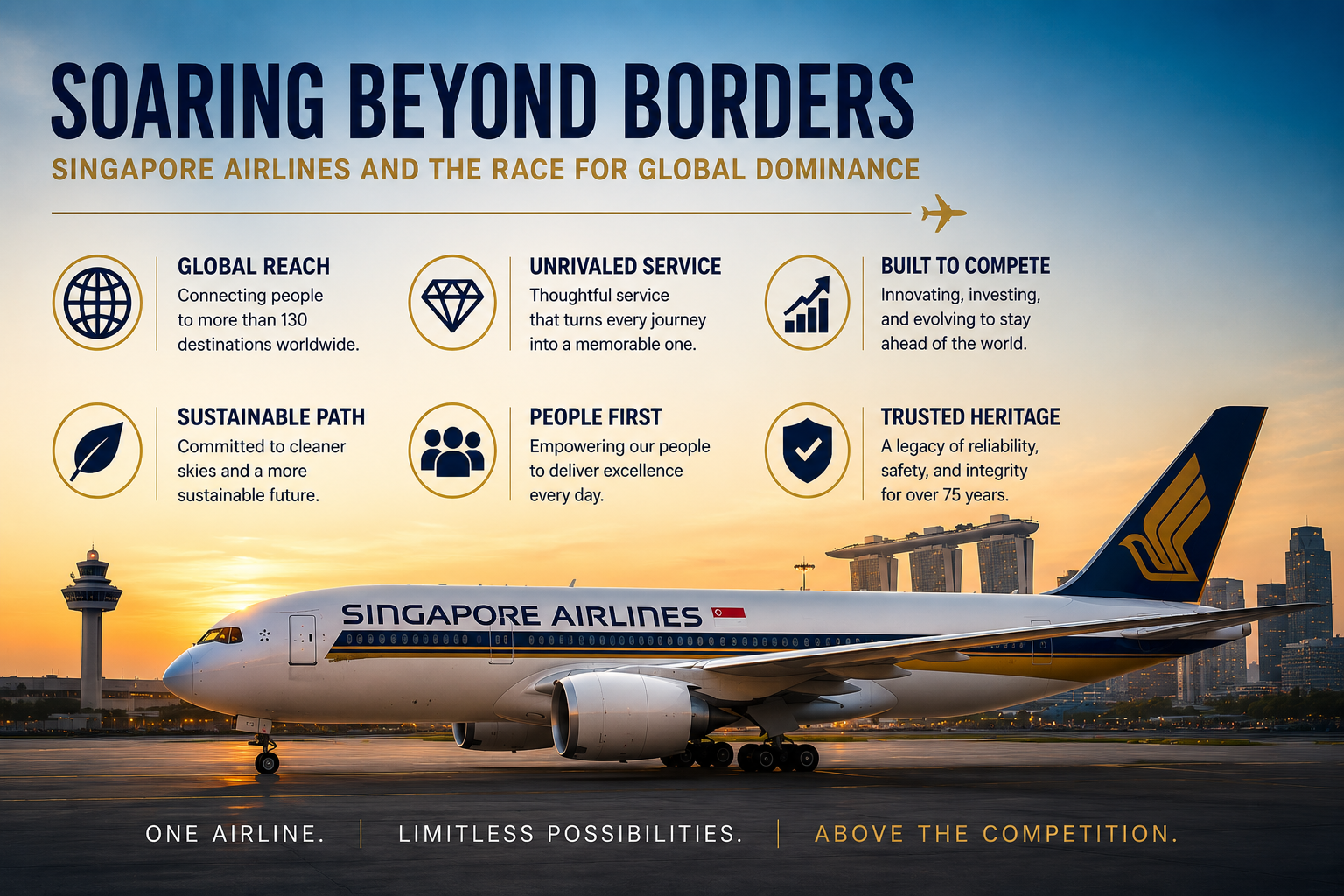
Somewhere past the runway lights, another aircraft is already staged, waiting for departure toward London, Sydney, Tokyo or New York. By 2026, Singapore Airlines isn’t only operating flights anymore , it’s kinda moving beyond that entirely.
It’s chasing something far bigger global aviation dominance.
The airline industry shifted dramatically over the last few years. Travellers are more demanding. Competition has tightened across almost every international route. Airlines don’t just spar with ticket prices or route maps.
They compete with experience, technology, speed, comfort, branding, loyalty programs, sustainability plans, and operational reliability, all together, at the same time really.
And Singapore Airlines still sits among the strongest contenders in global aviation.
At Singapore Changi Airport, the scale of air travel hits you immediately. Travellers drift through giant terminals crowded with luxury stores, indoor gardens , digital screens, waterfalls, lounges, and seemingly endless departure gates linking nearly every continent.
Changi Airport doesn’t feel like a traditional airport anymore. It feels more like a whole small city built around motion and flow.
That’s on purpose.
Singapore understands aviation better than most countries, because the nation depends a great deal on global connectivity.
Tourism, trade, finance, technology, shipping, and international business all lean on constant movement through the city-state. Aviation became part of Singapore’s national identity a long time back, and it still shapes how everything is designed today
The country built one of the world’s most admired travel ecosystems, because of it maybe not just one thing but yeah, mostly.
Singapore Airlines sits right at the center of that system.
For decades, the airline developed a reputation for precision, luxury, steadiness, and service quality that competitors constantly try to mimic, in a very polite but sort of desperate way.
Passengers flying long haul routes often compare every premium moment against Singapore Airlines standards, because the brand sort of became linked with polished global travel.
But that reputation also brings an enormous pressure. Modern travellers now expect perfection from premium airlines. A delayed departure , weak onboard Wi-Fi, poor customer communication, or uncomfortable seating can spark global criticism within hours via travel videos online reviews, and social media posts .
It spreads fast, like too fast.
Airlines kind of live under a spotlight now. Every delay, cabin review, or passenger complaint spreads online almost instantly, so reputation can move overnight, like in a blink. Singapore Airlines knows staying ahead isn’t only about a solid brand anymore, it has to keep evolving, while Gulf carriers, European airlines, American giants, and fast-growing Asian competitors keep pushing even harder into global routes, and it’s not a small thing.
The fight for long hour travellers it feels extra intense for across the Asia Pacific skies. And Flights that connect with Singapore and London, Paris, Sydney, Frankfurt, Los Angeles, Tokyo, Dubai, and New York sit among the busiest city, and most competitive routes, anywhere in the aviation.
Airlines chase premium passengers pretty aggressively because business class and first class travellers bring in a big chunk of airline profits.
That rivalry transformed cabin design.
Modern premium cabins barely look like the old fashioned aircraft seats anymore, not even close. Singapore Airlines keeps upgrading its business class suites with roomier layouts, sliding privacy doors, upgraded bedding , luxury dining experiences, wireless charging setups and also more tailored entertainment tech.
Passengers don’t just want a ride anymore.
They want comfort that feels sort of emotionally quieting during trips that can stretch twelve or fifteen hours.
Long haul flying honestly tests patience in strange ways. Time seems to behave differently inside cabin spaces while the plane is up there, suspended over oceans overnight. Airlines know people remember every bit of discomfort pretty clearly after exhausting international travel.
So, that’s why the details are matter so much, even when they seem small. Cabin lighting now shifts in gradual steps to help reduce jet lag. Newer aircraft improved humidity controls .
Seating ergonomics got better in a practical, day-to-day way. Even meal scheduling lines up more carefully with destination time zones, because airlines want travelers arriving less drained and more steady.
At the same time of every aircraft will be itself became part of the comfort with experience. Singapore Airlines are poured major investment into the newer fleets because modern aircraft they are don’t just improve efficiency for the airline but also they will make long-haul travel feel smoother, quieter, and far less exhausting for every passengers.
Quieter cabins, larger windows, smoother air pressure systems and better fuel efficiency make a real difference during ultra-long-haul operations.
And Singapore operates some of the world’s longest routes, which brings its own kind of problems. Passengers flying nonstop between Singapore and North America live inside the cabin for an enormous amount of time.
In that stretch, tiny discomforts start to feel huge, especially when the journey crosses multiple continents and time zones.
That’s where operational discipline turns into something critical.
Singapore Airlines built its reputation partly through consistency. Flights generally operate with careful precision.
Cabin service follows highly refined standards. Ground operations move efficiently. The airline understands luxury travellers value reliability almost as much as comfort.
Still, modern aviation feels increasingly difficult to control.
Global passenger will demand the surged again in 2026, while airlines run tighter timetables and narrower are operational margins than before.
The aircraft end up spending less time parked between flights because airlines want maximum efficiency from those costly fleets, and yeah there is hardly any room to breathe when disruptions show up.
Even a single delayed arrival can end up snowballing into a whole international network, which is not ideal.
Weather disruptions still mess with schedules all the time. Technical maintenance issues remain unavoidable in aviation , it’s basically part of the job description.
Meanwhile, airspace across for Asia and Europe keeps that getting more crowded in every year, and fuel prices keep on swinging without much warning. Airlines are always pushed to the stay efficient, but the passengers still wants every trip to feel seamless and stressfull free.
Singapore Airlines has to manage all of this, while going head-to-head with some of the biggest carriers out there, plus the fastest-growing names too. Gulf airlines, especially the ones based in Dubai , Doha and Abu Dhabi , keep expanding their long-haul footprint and throwing serious money into luxury onboard experiences.
European airlines still look strong in the business travel space, Chinese carriers keep building steady momentum for international routes, and American airlines continue to dominate key transpacific connections.
The competition doesn’t really slow down, not even for a second.
That’s why Singapore Airlines still keeps pushing technology aggressively throughout operations. Artificial intelligence now helps with maintenance prediction, passenger flow management, route optimization, fuel planning, and operational scheduling.
Digital systems track aircraft performance continuously while advanced analytics quietly cut delays before passengers even notice anything might be off.
Technology kinda powers modern aviation in the background, almost like a hidden engine.
Passengers mostly notice the visible stuff mobile boarding passes, faster check ins, digital baggage tracking, and those real time gate alerts.
But underneath all that, there’s this huge operational complexity, basically managing thousands of moving parts at the same time 24/7 , and it’s kind of wild.
Inside Changi Airport, the technology just blended naturally into the travel experience. Facial recognition systems, automated immigration gates, smart baggage tracking , and digital navigation tools help people move through the terminals quickly and smoothly without making the place feel overly confusing or stressful.
Speed matters now.
Travellers became less patient in recent years. Long security lines frustrate people instantly. Weak communication travels online in minutes. Airlines and airports know modern passengers compare experiences globally, not just locally.
One memorable travel video can shift how people book, worldwide.
One chaotic airport moment can hurt reputation just as quickly.
Singapore understands branding extremely well because the country set itself up as a premium global destination long ago. Aviation supports that image directly. Clean terminals, efficient systems, luxury lounges, and polished customer service all keep reinforcing Singapore’s reputation internationally.
Business travel stays seriously important for that strategy.
Singapore keeps pulling in finance companies, tech groups, global investors, manufacturing partnerships, and even major international conferences from every direction. People keep moving through Changi Airport, nonstop basically, and the airlines compete pretty hard for that loyalty.
Premium travellers want it all to feel smooth, from check-in right through arrival
and that expectation fuels ongoing innovation.
Meanwhile tourism in Singapore also keeps climbing. Travellers show up looking for luxury shopping, futuristic architecture, food culture, entertainment districts, business possibilities, and high-end hospitality moments.
Aviation kind of links it all together, without air travel Singapore’s whole economic setup would look completely different.
Because of that dependence, the country ends up leaning toward constant aviation investment.
But there’s also environmental pressure which is kinda reshaping aviation strategy, as well. Airlines are dealing with more scrutiny around emissions and fuel use, especially on those ultra long-haul routes. Singapore Airlines sees that sustainability can’t stay a small side topic in aviation anymore.
Passengers are asking more environmental questions before booking flights tickets, and the governments across the several regions to be tightening in sustainability expectations too. The aviation industry are moves slow, yet to be change is happening Sustainable aviation fuel projects are expanding and the airlines are upgrading to newer aircraft that burn less fuel, and produce fewer emissions.
Singapore Airlines are putting serious focus to the cleaner operations because they will be staying competitive in the future of depend heavily on how well airlines adapt to the environmental challenges for every pessengers. Singapore Airlines is putting real effort into cleaner operating tactics, because long-term competitiveness is increasingly tied to environmental adaptation.
Still, the challenge feels enormous though.
Global travel demand keeps climbing while environmental expectations feel stricter each year, you know? Airlines have to juggle growth with profitability passenger comfort, and sustainability all at the same time.
Nobody airline has really solved that whole equation perfectly yet, not even close.
Singapore Airlines, it’s trying to get ahead of the curve before the next big transformation arrives for real.
The future of aviation will be probably depend less on size and more on how quickly airlines can be adapt. Travellers are now expect the seamless digital experiences, for cleaner operations, dependable service, flexible booking tickets options, personalized attention, and fast updates whenever delays or disruptions for happens.
Airlines that moves too slowly risk getting left behind. Singapore Airlines seems fully aware of that, and it’s clearly determined to stay ahead of the curve.
Every evening, aircraft will continue the rising above of Singapore’s glowing skyline, and carrying passengers towards to the cities which spread across the Europe, North America, Australia, the Middle of the East, and Asia. Inside the cabins, will travellers settle into the quiet rhythm of long haul flying while the steady hum of the engines that cuts through the darkness of outside.
The race for global aviation leadership is still happening way above the clouds.