






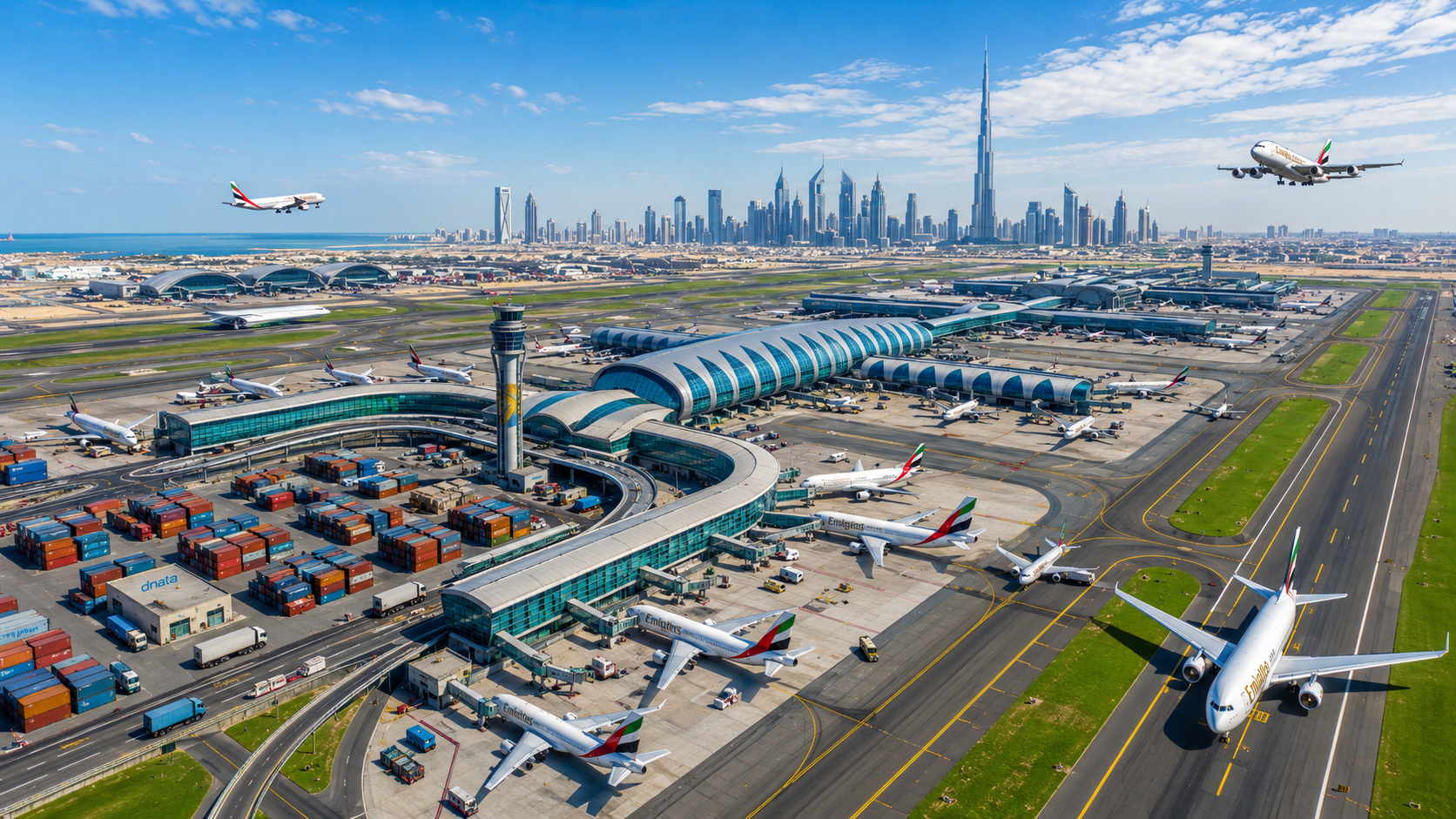
The runway lights sort of glow against that desert night, while another wave of aircraft descends toward Dubai’s crowded skies.
Wide-body jets arrive from London, Mumbai , Singapore, New York, Johannesburg and Sydney almost at the same time, like nobody even sleeps, or maybe they do but not really.
Inside the terminals, travelers drift through polished halls with shopping bags , passports, laptops, and coffee cups in hand.
Meanwhile the giant digital boards flicker nonstop, showing departures bound for nearly every corner of the world, and then some.
Dubai’s aviation machine rarely slows down anymore. In 2026 it feels larger, quicker, and more driven than ever, like it’s always adding another layer.
The city built its global identity around motion. Trade moves through Dubai. Tourism fuels huge parts of its economy.
Luxury hospitality keeps expanding, almost stubbornly so. Business travelers show up daily for finance, technology, construction, and those international partnerships that always sound slightly formal.
Aviation sits right in the middle of everything, connecting the Gulf with Europe, Asia, Africa, and North America through one of the world’s busiest travel networks, like it’s nothing special, but also somehow it is.
Inside Dubai International Airport, the vibe during peak hours feels almost like a scene from a film . You get travellers moving fast between gates under glowing advertisements, and it’s that constant motion that stays with you.
Airport trains glide passengers across massive terminals that are packed with luxury stores lounges, restaurants, and waiting spaces that never really look empty .
Outside, aircraft keep taxiing, and they keep going without pause. The whole site runs like a city that doesn’t ever fully close , not even for a moment.
Dubai’s aviation expansion didn’t happen by accident . Dubai set itself carefully between East and West, and from that it built one of the most strategically connected aviation hubs on the planet.
Flights moving between Europe and Asia often take, roughly , the Gulf route through airspace, and Dubai converted that geographic edge into serious global reach, not just a small influence.
That strategy changed the way global travel happens, like for real, permanently.
Passengers who used to depend on straight long haul routes started, bit by bit, connecting via Gulf airports because airlines brought newer aircraft, smoother service, competitive pricing , and access to international networks that are growing really fast.
Dubai didn’t stay just a quick stop anymore. It turned into one of the world’s main aviation crossroads , kind of the go to hinge between regions.
The whole size of it, it feels staggering now. Hundreds of flights move through Dubai daily, carrying millions of passengers every month , no really it’s nonstop.
Dubai’s airlines keep adding routes aggressively while overall international travel demand stays strong across several regions, and that kind of momentum doesn’t seem to ease.
Tourism keeps rising, corporate trips don’t slow down, global events keep coming, and luxury hospitality keeps pulling people in so passenger numbers climb year after year , like clockwork.
Right in the middle of this expansion sits Emirates, one of the most recognizable long-haul carriers on the planet.
Emirates helped reshape luxury international flying through a very big aircraft park, premium onboard service, and nonstop world wide connectivity.
And because of that, Emirates made Dubai a symbol of modern aviation ambition.
Even the airline’s fleet feels like part of the city’s identity now. Big aircraft basically fill Dubai’s runways all the time. Double-decker jets with hundreds of passengers arrive and depart throughout the day, while crews coordinate incredibly tight timings behind the scenes.
Airlines operating through Dubai push aircraft utilization very hard , since global demand is still extremely high. That whole setup brings enormous operational complexity with it.
Every delayed aircraft messes with connecting passengers who are trying to move toward dozens of destinations across continents, and it happens fast, like really fast, too. One disrupted departure can set off scheduling issues that stretch across Europe, Asia, and Africa within hours because modern aviation systems basically run with almost no spare minutes built in.
Passengers don’t usually see that pressure underneath everything.
They mostly feel the polished face of the whole trip.
Luxury lounges. Smooth boarding routines.
Giant duty-free shopping zones. Digital check-in procedures. High-end airport hotels. Quick transfer systems.
Dubai built its aviation reputation on this kind of seamless experience design, not just on service.
The city gets it, modern travellers now expect speed together with comfort. Long lines annoy people almost instantly. Weak communication causes immediate online backlash.
Travellers also compare airports globally through videos, reviews, and social media posts within minutes after they land.
Visibility changed the aviation business almost overnight.
That’s why Dubai keeps pouring money into automation, biometric tools, AI-assisted passenger movement control, and upgraded airport infrastructure made to keep traffic moving efficiently even when peak congestion hits.
Inside terminals, facial recognition systems are becoming more common. Automated boarding gates move travellers through quicker.
Smart baggage systems boost reliability, and digital notifications keep passengers informed constantly via mobile apps.
Technology, quietly , powers a lot of Dubai’s aviation advantage.
Passengers may not notice each system working behind the scenes, but they still feel the benefit, kind of through shorter waiting times, smoother transfers , and travel days that feel more predictable.
Like, you get the impact without really watching the gears, or whatever you wanna call it.
Over time, the whole airport experience itself started acting as part of Dubai’s global branding strategy not just an operational necessity.
Everything seems arranged to build scale and spectacle at the same time, almost like those two goals were planned together as one single idea.
And you can see it right away: massive terminals spread across enormous spaces, packed with luxury architecture, bright lighting, polished surfaces,and nonstop activity that doesn’t really pause.
Travelers often sit in Dubai’s airports for hours during long layovers, and the city purposely turned that waiting window into a real part of the journey, instead of it being just empty downtime.
That same approach also shifted how airports think worldwide. Modern aviation hubs increasingly chase passenger loyalty by offering comfort, entertainment, shopping, dining ,and premium services, rather than operating only as transportation facilities.
Dubai pushed that shift forward aggressively.
Meanwhile, fuel prices are also kind of a hurdle lurking in the background. Aviation depends so much on stable fuel economics, and jet fuel costs keep shifting around in ways that are not easy to forecast in 2026.
So airlines end up having to redo schedules all the time, tune their pricing playbook, reimagine aircraft assignments, and tweak operational planning just to stay in step with that changing fuel picture.
Luxury cabins grew bigger, more private, and more technology-focused because airlines understand that business class and first class passengers generate enormous revenue.
Cabin design has been evolving, rapidly, and not quietly. Private suites, onboard showers, lie-flat seating, luxury dining experiences, wireless charging systems, and upgraded entertainment technology are increasingly showing up as standard on many Gulf operated long haul routes.
The idea is simple, airlines want passengers to remember the journey itself, not only the destination.
Even economy passengers expect more too.
Travellers flying across very long distances now seem to expect a better Wi-Fi, cleaner cabins, more comfortable seating, stronger entertainment systems, and clearer communication when disruptions pop up.
Airlines that operate via Dubai know this too, because small annoyances can suddenly feel… kinda huge during a fourteen hour stretch, you know?
That kind of pressure pushes nonstop innovation, even when no one is watching too closely.
At the same time, fuel prices are another hurdle working in the background. Aviation relies a lot on steady fuel economics, and jet fuel costs keep moving around in ways that are hard to predict in 2026.
So airlines have to constantly rework schedules, update pricing strategies, rethink aircraft assignments, and adjust operational planning to match the changing fuel picture.
Passengers usually only notice the results indirectly, like a ripple effect. A ticket price goes up without much warning. A once year-round nonstop route turns seasonal.
Flight frequencies shift quietly, mostly between the lines. Airlines rarely publish every operational micro change, yet travelers still end up feeling the consequences when they’re trying to book.
And then there’s the environmental pressure reshaping Gulf aviation as well.
The industry faces higher scrutiny about emissions and sustainability, especially because overall travel demand continues to rise fast. Dubai’s aviation community understands that adapting for sustainability is becoming unavoidable, even for regions that basically grew around rapid aviation expansion.
Sustainable aviation fuel projects are still sort of rolling forward, step by step, bit by bit. Airlines meanwhile keep putting money into newer aircraft, that are meant to cut emissions and, at the same time, boost fuel efficiency overall.
Airports are also modernizing the ground operations with cleaner technologies and energy efficient infrastructure upgrades, even if it feels slow in places.
Still, the transition stays complicated.
Air travel demand keeps rising while environmental expectations get stricter at the same time, which is kinda awkward really.
Trying to keep both realities aligned may become aviation’s biggest headache during the next decade.
Tourism keeps pushing Dubai’s expansion, and it does it in a rather aggressive kind of way, kind of like it can’t slow down. Travellers land wanting luxury hotel stays, shopping areas, beach time, nightlife, architecture, business opportunities, sport events, and entertainment that feels almost larger than life, you know.
Corporate executives, technology investors, construction firms, financial institutions, and international entrepreneurs they keep moving through Dubai, because the city kind of positioned itself as a major commercial bridge linking a few regions together, so everything flows.
Flights connecting Dubai with London, Mumbai, Singapore, Riyadh, New York, Paris, and Hong Kong remain among the busiest international routes in global aviation, no doubt about it.
So, because of that, the skies above the Gulf are getting more and more packed, almost daily.
Air traffic controllers handle intricate flight diagrams every day, while aircraft slide through tightly scheduled international air lanes that tie Europe, Asia, and Africa together, in a neat yet relentless rhythm.
Modern aviation systems depend heavily on precise timing and real-time digital coordination, in order to keep congestion from turning into a full mess, too quickly.In practice aviation supports almost all of that tourism ecosystem, from arrival to quick repositioning and back again.
Without flights, Dubai’s global economic setup would look completely different.
That reliance basically steers the city toward continuous aviation growth.
New terminals, expanded runways, upgraded air traffic systems, and future-minded airport plans keep showing up inside long term infrastructure strategies.
Dubai is getting ready for passenger numbers even bigger than today’s already enormous figures.
Business travel is still critically important too.
Corporate executives, technology investors, construction firms, financial institutions, and international entrepreneurs keep moving through Dubai, because the city has positioned itself as a major commercial bridge linking several regions together.
Flights connecting Dubai with London, Mumbai, Singapore, Riyadh, New York, Paris, and Hong Kong stay among the busiest international routes in global aviation.
Because of that, the skies above the Gulf are getting more and more crowded.
Air traffic controllers deal with intricate flight patterns every day, while aircraft move through tightly scheduled international air corridors tying Europe, Asia, and Africa together.
Modern aviation systems depend a lot on precise timing and real-time digital coordination, to keep congestion from sliding into chaos.
Passengers usually never notice.
They just hop onto flights and act like the system will work smoothly, no friction at all. Behind each big departure there is this huge coordination, between crews, air controllers, dispatch people, software systems, maintenance engineers, fuel operations, baggage handling, and airport logistics staff, all doing their thing more or less nonstop and together, in some kind of routine that looks easy but isnt.
The whole scale feels kinda invisible unless something small goes wrong, or then suddenly it isnt small anymore. Dubai’s aviation empire keeps expanding because the city gets a plain reality better than a lot of rivals, global movement still counts, it matters a lot.
People keep traveling for business partnerships tourism education, luxury experiences, sporting events, family ties and economic opportunity too, even with higher costs and extra operational headaches.
The demand hasnt really faded. If anything, it has gone more worldwide than before. Every evening aircraft keep climbing above Dubai’s bright skyline, taking travelers toward cities spread across continents.
The terminals stay lit well past midnight while departure screens refresh and refresh, with destinations arriving one after another, like nobody is ever done.
The motion never truly pauses. And somewhere under that desert night, another plane begins to accelerate down the runway, toward the dark open sky ahead.