







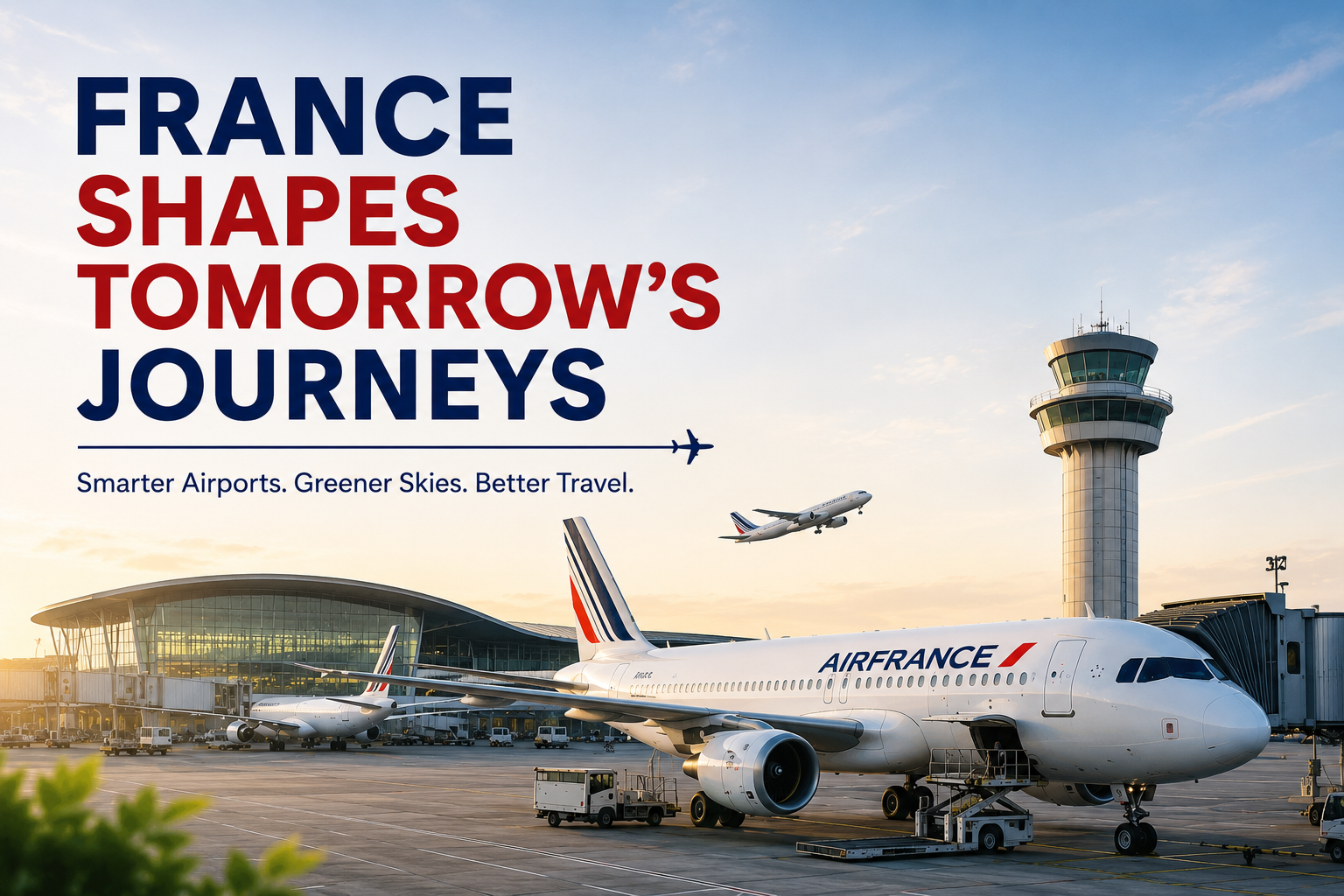
The morning rush starts before sunrise, like almost a habit. Travelers drag suitcases over shiny terminal floors while departure boards blink nonstop updates above packed waiting areas. Out beyond the glass, aircraft queue along rain-drenched runways under gray Paris skies .
Ground crews dart between gates, and somewhere far off engines roar, kind of softly but still persistent. In 2026 France’s aviation system feels alive again, yet something more layered is shifting underneath all this motion.
French aviation is sliding into a different era, maybe even a rough new one. The nation that helped shape modern air travel is now rebuilding its aviation future with tech, sustainability , passenger ease and operational speed all at once, with no space to hesitate.
Airports are getting smarter, not just larger. Airlines are refreshing their fleets faster than expected. Travelers are also moving through trips in a different way. The older tempos of air travel are still around, but the whole industry around them looks increasingly reworked, somehow.
Inside Paris Charles de Gaulle Airport, the vibe feels almost nonstop now. Long-range flights roll in from Asia, North America, Africa, and the Middle East, while European departures leak out every few minutes toward towns and connecting hubs spread across the continent.
The airport runs like a huge mechanism driven by timing, coordination and constant motion.
Passengers rarely catch the behind-the-scenes messiness underneath it all. Behind each departure there’s a web of software systems, maintenance teams, dispatch operations, baggage handling, air traffic control coordination, catering logistics, fuel tracking, and aircraft scheduling all working at the same time.
Modern aviation depends on thousands of moving fragments that need to stay aligned, without interruption, without mercy. France seems to grasp this kind of pressure better than most countries.
Air travel demand has climbed again across Europe. Tourism returned aggressively. Business trips stayed steady. International events keep drawing enormous crowds into French cities every month. Airports, deal with more passengers every week , and the pace keeps tightening.
while airlines run even tighter schedules than before. Put those things together and you get a mix of opportunity and stress, sort of all at once.
Inside terminals, people move fast between gates with backpacks, coffee cups, passports, and smartphones that show digital boarding passes. Nowadays mobile apps basically run the whole thing, step by step.
Check-in becomes digital, not some slow desk situation. Then gate changes land instantly via notifications. Travelers keep an eye on delays in real time, still seated inside airport cafés watching planes taxi out past huge windows.
From the outside, it looks smoother. Everything seems easy, streamlined, almost calm. But underneath the pressure is still climbing. France’s aviation sector is pushing modernization very hard, because passenger expectations changed a lot in recent years, real fast.
Travelers have less patience now. Long queues frustrate people in minutes, and delayed baggage turns into immediate complaints online. When communication is weak , it spreads across social media within minutes, like it has its own engine. Airlines and airports understand that visibility has changed the rules completely.
Even one chaotic airport clip can reach millions overnight.
So, that’s why French airports are pouring serious money into automation , biometric systems, AI assisted passenger flow management, and terminal layouts that feel smarter overall, aiming to take the edge off the stress in those packed travel moments.
At places like Orly Airport and Nice Côte d’Azur Airport, modernization work is sort of reshaping how people actually drift through terminals.
Facial recognition boarding is moving forward, but bit by bit, step by step. Automated baggage tracing helps reliability a lot.
Security now tends to get quicker, mainly thanks to smarter scanners and digital identity tools .
Modern airports are trying to hold both things together, which is harder than it sounds.
That balancing act is basically the core of a lot of France’s aviation shift in 2026.
Airlines operating across France are moving too. Long-haul competition has intensified fast across Europe, especially between European carriers, Gulf airlines, and those quickly expanding Asian aviation networks.
French airlines get it now passengers compare experiences worldwide, not only by region.
One strong international flight can turn into worldwide marketing, carried by travel videos and reviews.
But one bad experience, even just one, can damage reputation immediately.
So this pressure pushes airlines toward faster innovation.
In the cabin, you can notice changes, somehow. Business class seating is getting more discreet, more roomy and a bit more technology driven. Airlines are reworking the premium cabins for passenger comfort, not just trying to cram in extra seats, you know.
Sliding privacy doors, upgraded entertainment systems, wireless charging stations, luxury bedding, and restaurant-style dining are appearing as more or less standard on a lot of international routes.
Even economy cabins are changing slowly, in their own quiet way.
Passengers flying long distances expect stronger Wi-Fi, cleaner interiors , better lighting systems, quieter cabins, and improved seat ergonomics.
Airlines understand small detail , matter enormously during flights lasting ten or twelve hours.
A broken entertainment screen feels worse halfway across the Atlantic, and it’s kinda like you can’t really escape it.
So does poor communication during delays, no one wants that part.
French aviation companies are also placing enormous focus on sustainability because environmental
Pressure across Europe keeps getting, more intense, even if schedules stay pretty much the same. Aviation remains under scrutiny for emissions and fuel consumption, not just in one place, but everywhere.
France’s government, environmental groups, and a lot of travelers are pushing for cleaner aviation solutions, and they want it sooner than before.
In the meantime, the industry understands that change is unavoidable, even if nobody is rushing it. Sustainable aviation fuel projects are spreading across France, as airlines look for workable ways to cut environmental impact, while still keeping global connectivity intact.
Also, new aircraft are arriving in airline fleets, and they tend to use less fuel while producing lower emissions. Airports are putting money into electric service vehicles, better terminal operations that are cleaner, and more energy-efficient infrastructure.
The transition won’t happen overnight. Still, momentum is building.
Electric aircraft development also keeps moving forward, but slowly. Short regional routes may eventually see hybrid or electric-powered operations become more realistic during the coming years.
French aerospace companies are investing heavily in future technologies because aviation competition increasingly depends on innovation.
France wants to remain at the center of that future.
The country already holds enormous influence inside global aerospace manufacturing. Companies connected to Airbus continue shaping aircraft design, fuel efficiency improvements, and aviation engineering around the world.
That influence matters, strategically. Like, it really does. Modern aviation isn’t only about moving people anymore, it’s more like technology leadership, environmental adaptation, passenger psychology, logistics systems, and international economic power all running together, almost like one engine.
Passengers themselves changed too. Honestly, they behave differently compared to previous generations. People are monitoring flights constantly through apps, and they do it almost like reflex.
Travelers tend to arrive earlier at airports because they assume disruptions might happen especially during peak times and busy periods.
Flexible tickets became more popular, partly because passengers already know schedules can shift in unexpected ways, you know.
Airlines are adapting their communication strategies around this behavior. Passengers don’t just want updates. They want fast updates. And if there’s silence during disruptions, the frustration kicks in immediately, no warning.
France’s airports are therefore investing heavily in live passenger information systems, aimed at keeping travelers informed continuously during delays, gate changes, or schedule disruptions. Not just occasionally, but in a steady manner.
Business travel also came back strongly across France during 2026, though it feels different now.
Companies travel more selectively than before, but honestly face to face meetings still carry weight, specially for finance , luxury industries, technology partnerships, fashion shows, manufacturing, and international trade.
Paris remains one of the world’s more influential business and tourism cities, which practically means nonstop pressure on aviation demand all year long.
Flights that connect Paris with New York, Dubai, Singapore, Tokyo, London, Los Angeles, plus key African cities are still some of the busiest long-haul corridors across Europe.
Airlines compete pretty fiercely for passengers on those routes, and that’s because high-end travelers deliver enormous revenue, like it’s a direct lever they can pull, quickly.
Tourism adds another layer of intensity, and it doesn’t really ease up.
Millions of international visitors keep arriving in France, looking for this food culture thing, museums, old historic landmarks, beaches, mountain resorts, fashion districts, wine regions, sporting events, you know.
During the summer periods it gets especially intense and that puts a massive strain on airport systems because leisure travelers and business passengers basically overlap, almost like the same tide.
The terminals fill up fast, real fast. Air traffic controllers manage these increasingly packed skies over Europe every single day, and it’s not the simple kind of “one aircraft at a time” picture most people imagine.
The hidden choreography behind modern air travel became, somehow far more complicated than most passengers ever realize. Aircraft remain on tightly managed flight paths while software systems keep doing the figuring, spacing, altitude tweaks, weather patterns, and route efficiency across congested European airspace, all day long.
France sits right inside one of the worlds busiest aviation regions, so. which means that there is an enormous operational complexity, piled up together, constantly.
A delayed departure in Paris can end up affecting aircraft schedules across Madrid, Amsterdam, Frankfurt, Milan and London within hours, because European aviation systems are deeply interconnected, like a network that never really sleeps.
Passengers usually see only the final delay notification. They don’t really see the thousands of operational calculations happening behind the scenes, meanwhile.
And weather still causes major disruptions too. Storm systems, heavy rain, strong winds, and seasonal fog keep hitting European aviation regularly. Airports are technologically advanced, but weather still nudges the system toward operational limits during peak travel.
That’s why resilience became one of aviation’s most important priorities. French airports are expanding backup systems, predictive maintenance technologies, AI-assisted scheduling, and digital operational monitoring, meant to reduce disruption risks before passengers feel it directly.
Cargo aviation still plays a huge part in France’s aviation economy, not just in a small way but in a constant kinda background role. Aircraft move luxury goods, pharmaceuticals, electronics, industrial equipment, fashion products, and other high-value exports to places worldwide, every single day.
The airport never really sleeps, not in practice.
That steady motion, it kind of becomes the whole definition of modern aviation.
Inside the terminals, travelers keep moving through automatic doors, under glowing departure screens. Meanwhile aircraft go up into the dark sky one after another, carrying passengers toward far away cities across multiple continents.
For many frequent travelers, it feels almost routine, like a daily pattern that barely changes.
Still, aviation remains one of the most complicated systems humans run each day. France’s aviation shift mirrors something bigger going on globally.
Air travel is becoming more digital and more automated, yes, but also more environmentally minded, and more passenger focused at the same time. Airports aren’t just transport points anymore.
They’re turning into tightly connected ecosystems, powered by technology and real-time coordination, even when nobody really looks at it closely.
The future doesn’t arrive in one dramatic moment.
It’s already unfolding, quietly, inside terminals, cockpits, control towers, baggage systems, and even aircraft cabins, every day.
Passengers might not catch every operational tweak happening around them, but they still feel the outcomes.
Less time waiting. Faster boarding. Smarter updates, cleaner terminals. Quieter cabins, smoother international journeys. France is trying to sketch that future ahead of the rest of the industry fully catching up, somehow. And every evening, under those glowing runway lights outside Paris, another aircraft rises up in the sky, and carries that future with it.