






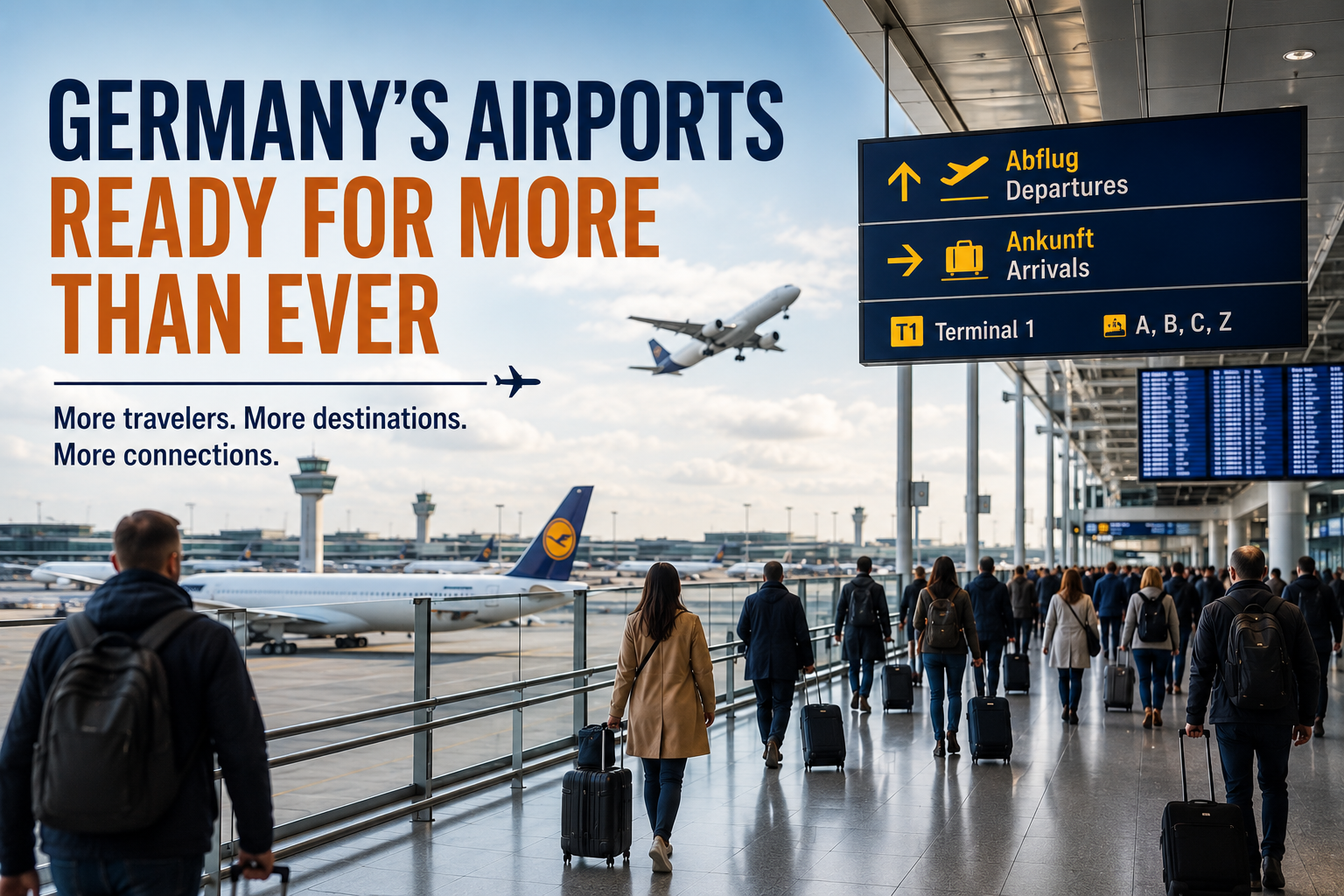
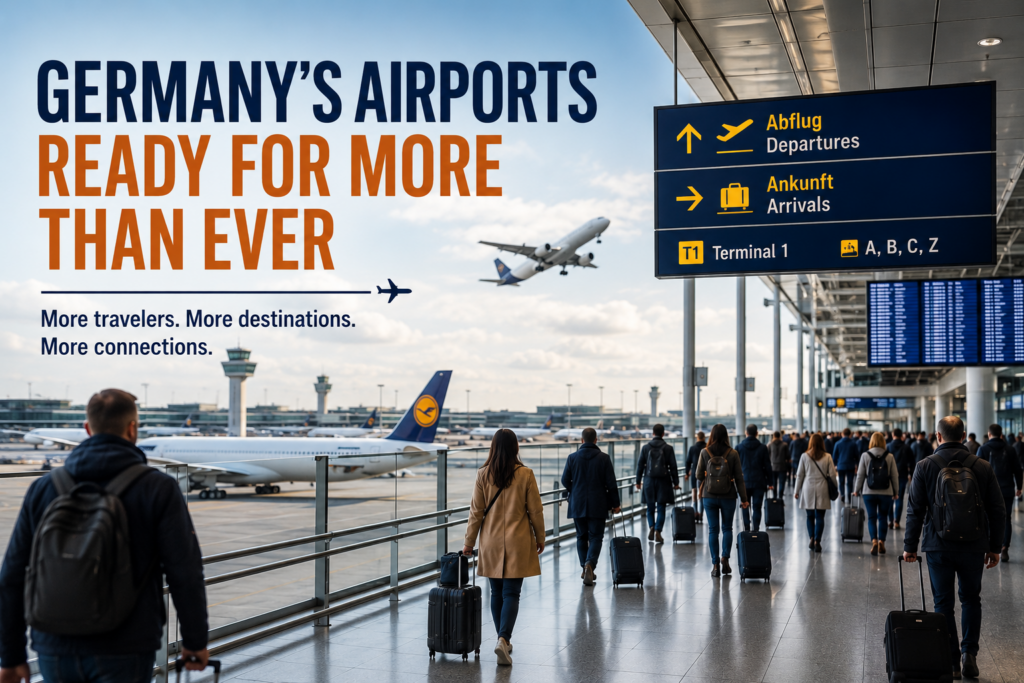
The sound arrives before the aircraft shows up. A low mechanical roar rolls across the runway, while travelers inside the terminal kind of pause and glance toward huge windows aimed at crowded taxiways. Another jet touches down, and the whole scene changes fast. Ground crews move immediately.
Baggage carts run across those marked lanes, and then the departure boards refresh again, with gate swaps that feel kind of abrupt, plus boarding announcements that seem to show up out of nowhere. Germany’s airports feel alive once more, but in 2026 the whole rhythm is way more intense than it was before—almost urgent.
Passenger numbers are climbing quickly across the country. Airports that used to fret about a sluggish recovery are now pushing through packed terminals, overloaded timetables, and this nonstop motion from sunrise until well past the night. it’s like everything keeps moving, even when you think it should pause.
People are flying for business meetings , concerts, sports events, trade fairs, family vacations, and also those quick weekend city breaks. The pace just keeps pressing forward, again and again.Inside Frankfurt Airport, travelers pass through one of Europe’s biggest aviation hubs almost continuously. Flights roll in from Asia, North America.
the Middle East, and every corner of Europe too. The airport works like a giant living system, where timing matters down to the minute.
If one aircraft is delayed, it can ripple across dozens of connecting routes before anyone even thinks something has shifted.
Germany also sits in a strong spot for global aviation. Planes moving between continents often pass through German hubs because the country links major economic corridors with tourism pathways in the same corridor stretch.
That geographic advantage mattered even more after international travel demand bounced back in 2026.
Business travel is back in a strong way across Germany’s aviation network, you know the kind, corporate executives technology specialists, engineers, financial consultants, and manufacturing partners are traveling regularly once again.
Germany’s role in automotive production ,industrial engineering finance, and global trade keeps airports busy all year long, no real off season.
Cities like Frankfurt, Munich, Berlin, Hamburg, and Düsseldorf still pull international business travelers in every day. Conferences fill up hotel districts and trade exhibitions bring thousands of overseas visitors with them, like clockwork.
Airlines react by pushing higher flight frequencies and restoring routes that sort of disappeared years ago.
At the same time, tourism is growing pretty aggressively too. Germany draws millions of visitors looking for old towns, castles, mountain scenery, Christmas market vibes, football culture, museums and festivals. And the summer months now create huge day to day operational pressure across airports, because holiday demand overlaps with corporate travel timetables. Sounds simple, yet it changes everything.
So airports don’t really get those quiet recovery phases anymore. Instead they operate under near constant pressure. Inside terminals like Munich Airport, movement feels relentless during peak hours.
Security checkpoints can end up stretching longer than expected, boarding areas fill faster, and restaurants stay busy, all the time. Charging stations get taken almost immediately.
while travelers stand there watching mobile app updates for gate changes or delay notices.
Pressure spreads behind the scenes too, even where nobody sees it directly. Airlines are planning routes and assigning aircraft a little more aggressively, than they used to, and planes often end up lingering less time on the tarmac between flights.
It’s mostly because companies want maximum efficiency from every single aircraft in the fleet, or something close to that, even when nobody is paying attention.
This operational approach can boost profitability, but it also leaves hardly any breathing space when issues suddenly show up.
Even a short delay on one arrival can end up causing weird domino effects across an entire schedule. And then weather makes it harder. Fog, thunderstorms, winter snow, and strong winds still affect German aviation pretty regularly.
Airports are more capable technologically than ever before, but conditions still create chain reactions across European airspace.
So for example, a storm over Frankfurt can spill over and affect departures in Amsterdam, Paris, Vienna, Zurich and London within hours, because modern aviation systems are really tightly tied together, like connected machinery.
Passengers usually only see the very last delay message. They don’t catch the hidden intricacies behind it, the behind-the-scenes mechanics that build up quietly , step by step.
Air traffic controllers have to manage more and more crowded skies, while coordinating thousands of aircraft moving all at once across European airways corridors, without much forgiveness for timing.
Germany’s airspace has turned into one of the most busy aviation regions in the world, especially during the big travel peaks, when everything is already packed.
Technology now plays a huge role in keeping operations steady. German airports are investing a lot in biometric boarding setups, automated baggage tracking, AI-assisted scheduling tools, and digital passenger management systems that are meant to cut down congestion.
Travelers are increasingly walking through automated gates using facial recognition, rather than the older boarding routines.
In the end, the airport experience itself is changing pretty fast.
Passengers expect speed now. Slow check-in counters frustrate people almost immediately . Long security lines generate complaints online within minutes, like really fast. Airports get it , modern travelers compare everything nonstop through social media posts, travel videos and online reviews.
One kind of chaotic airport experience spreads across the internet incredibly fast
And that kind of visibility creates real pressure for airports and airlines to modernize continuously, or at least keep up.
Inside Germany’s major hubs , digital displays, mobile notifications , and live travel updates have become like the everyday core of passenger management. Travelers rely heavily on apps for boarding passes, gate changes, baggage tracking , and delay alerts.
Paper tickets already feel kinda outdated . It’s not just a trend , the whole aviation ecosystem became more digital almost overnight.
Low-cost airlines also reshaped Germany’s travel scene pretty dramatically. Budget carriers keep expanding routes aggressively across Europe , which makes international travel far more attainable for younger travelers, students, and short-term tourists. Weekend travel exploded , largely because fares got cheaper.
Passengers now travel between European cities the way older generations would go by train, you know, sort of. A quick jaunt from Berlin to Barcelona, or Munich to Rome, just feels… routine now, almost, like nothing special. Airlines also go after those travelers pretty aggressively, particularly during holiday periods.
That competition can push ticket prices lower on certain routes, even while operational costs keep rising behind the scenes. Fuel stays one of aviation’s biggest problems, no matter what.
Jet fuel prices, in 2026, seem to move in a way that nobody can properly guess, so airlines end up tweaking everything again and again. A route that looks profitable one month can suddenly feel pretty impossible after fuel spikes, and it happens fast.
At first the airlines react in a quiet kind of manner, not really announcing it, they just start doing changes. Frequencies get cut back, flight times get nudged a bit , and aircraft placements get swapped around more often than before.
Passengers usually only notice later, especially when they’re actually trying to book. Sometimes ticket costs jump a lot within days.
Other times the nonstop options vanish for a while, and then they come back months later with a slightly different rhythm, different schedules, maybe a different departure pattern, too. Still, the whole aviation economy stays delicate, even when passenger numbers look strong.
On top of all that there’s the environmental pressure, which adds a whole other layer for Germany’s airports and airlines.
Over the last few years, the climate talk around aviation got louder across Europe, you know. Governments, environmental orgs and even travelers themselves are asking for less emissions, and cleaner operations from airlines.
And honestly that pressure is starting to reshape, the way the industry thinks about its long term plans. Basically it’s changing everything, not just a little.
Sustainable aviation fuel initiatives are growing gradually across Germany. Airlines are rolling out newer aircraft meant to cut emissions while also boosting fuel efficiency, at the same time.
Airports are putting money into cleaner ground operations too, things like electric service vehicles and terminal infrastructure that uses energy more efficiently.
It’s not instant, the transformation comes slowly, but it’s definitely happening, it’s already underway.
Also, passengers are different now. Modern travelers act different from just a few years ago. People look at flight status constantly on their phones, through mobile apps and such. Travelers show up earlier at airports because they expect delays or other operational issues during busy periods.
Flexible ticket options became more popular as well, since passengers want some kind of coverage if schedules shift suddenly or get disrupted.
Airlines are adapting their communication strategies a bit more and more because travelers kind of expect instant updates whenever plans change.
Silence frustrates passengers, more than delays sometimes do, honestly. A quick notification explaining a disruption can stop enormous customer backlash online, before it snowballs.
Also competition between business class carriers intensified sharply across German aviation. Airlines know premium travelers generate huge revenue, especially on long-haul international routes that connect Germany with Asia and North America.
That competition pushed upgrades into aircraft interiors, pretty noticeably.
Modern premium cabins now offer lie-flat seating, private suites, better dining, faster Wi-Fi, larger entertainment systems, and more luxury airport lounge access. Airlines are trying to shape smoother long-haul experiences too because people spending ten hours inside aircraft cabins expect more comfort than ever, really. The experience matters.
Travelers compare airlines globally now, not just regionally like before. One exceptional flight review can influence thousands of future bookings, in practice.
Cargo aviation became even more significant within Germany’s airport ecosystem, and honestly it feels like that role keeps expanding, still among Europe’s largest export economies. Air freight is a huge driver in the global movement of electronics, machinery, pharmaceuticals automotive parts, and industrial equipment.
Cargo traffic keeps climbing at the same time as passenger travel, and because of that there is more day to day operational pressure on runways , schedules and the airport logistics systems.
The less visible side of aviation often stays hidden from ordinary travelers. Under every successful departure there’s this enormous network of mechanics, dispatchers, pilots, fuel crews, baggage handlers, air traffic controllers, catering teams, software systems, and airport operations staff coordinating continuously
Everything depends on timing, like really. Everything connects together somehow, even when it doesn’t look like it.
One technical issue during aircraft maintenance can ripple outward and affect passengers across multiple countries later that same day, which is kind of wild really.
Germany’s airports are, so therefore investing heavily in operational resilience. Backup systems , predictive maintenance technology, AI aided traffic management, and expanded terminal upgrades are all aimed to manage the rising travel demand more effectively, and quicker.
Yet still, the pressure keeps increasing, anyway.
International tourism isn’t slowing down. Business travel continues recovering strong, not quietly. Airlines keep adding routes, too many routes maybe. Travelers expect faster service and smoother airport experiences every year, like it’s normal.
The aviation industry now operates in constant motion, always. Inside crowded terminals travelers rush between gates with backpacks, coffee cups, laptops, shopping bags, and passports.
Screens flash updates in multiple languages while aircraft line up outside waiting for departure clearance, everyone checks everything twice.
The whole atmosphere feels exhausting sometimes, but also strangely exciting.
Because airports represent movement, possibility, and connection all at once. Germany’s travel surge reflects something larger going on across global aviation. People continue moving across borders at extraordinary speed despite economic pressure, environmental debates, and operational strain.
Flights stay essential for business relationships, tourism economies, international education, family connections and cultural exchange, even when the headlines complain.
That demand really keeps pushing airports to keep expanding.
Construction keeps rolling across terminals, runways, rail links, and all the passenger infrastructure stuff throughout Germany. Aviation leaders know this growth isn’t a quick phase or just a temporary thing.
They’re basically making plans for even busier years coming, whether anyone likes it or not.
The problem now is more about keeping a balance.
Airports have to grow, but without turning into something chaotic. Airlines also need to stay profitable, without dropping the passenger experience. At the same time, environmental targets should improve, even while flight demand keeps climbing year after year.
Honestly none of this feels really easy.
Still, every single evening, aircraft lift above German cities, carrying thousands of travelers toward places scattered across continents. The engines sound loud against the darkening skies, while terminals below keep glowing with movement nonstop.
And somewhere inside all that crowding, another departure board refreshes, again and again.